


Best Time to Visit Machu Picchu, Month by Month
The best months to visit Machu Picchu are May and September: dry mornings, green terraces and fewer people than June to August. The driest months are June to August, also the busiest. January to March bring about 13 in (340 mm) of rain a month and the Inca Trail closes every February. The sun clears the ridges well after the gate opens.

In this guide
Short answer: The best months to visit Machu Picchu are May and September: dry mornings, green terraces and fewer people than June to August. The driest months are June, July and August, which are also the busiest. The wettest are January to March, with about 13 in (340 mm) of rain a month, and the Inca Trail closes every February. Avoid building a trip around sunrise, because the sun clears the ridges well after the gate opens.
Machu Picchu has two seasons and no bad month. The citadel sits at 7,970 ft (2,430 m) in cloud forest, lower and warmer than Cusco, so it never freezes and it rains in every month of the year. What changes is how much it rains, how many people share the circuits with you and what the trains and trails are doing. This guide goes month by month with the weather normals, the crowd calendar and the dates that close things, then gives our pick for each kind of traveler. For the rest of the country, read the best time to visit Peru.
Machu Picchu month by month
The table below uses the climate normals for Machu Picchu from Peru's weather service, SENAMHI, for 1991 to 2020, as published in the Wikipedia climate table for the site. Daytime highs stay between 69°F and 74°F (20.6°C and 23.4°C) all year. Nights drop to about 49°F (9.4°C) in July and sit near 54°F (12°C) in the wet months. The number that moves is rain: 1.8 in (51 mm) in June against 13.4 in (341 mm) in January.
| Month | Rain (in / mm) | Day high (°F / °C) | Night low (°F / °C) | Crowds and capacity | Our pick |
|---|---|---|---|---|---|
| January | 13.4 / 341 | 69 / 20.6 | 53 / 11.8 | Low, 4,500 a day (5,600 on 1 January) | Quiet and green, book a mid-morning slot |
| February | 12.8 / 325 | 69 / 20.6 | 53 / 11.9 | Lowest of the year, 4,500 a day | Inca Trail closed, citadel open and empty |
| March | 13.4 / 341 | 70 / 21.0 | 53 / 11.9 | Low, 4,500 a day | Still wet, Inca Trail reopens 1 March |
| April | 7.2 / 184 | 71 / 21.5 | 53 / 11.7 | Low, 5,600 around Easter (2 to 5 April) | Showers fading, Poroy station reopens in May |
| May | 2.9 / 73 | 71 / 21.9 | 51 / 10.8 | Medium, 4,500 a day until 18 June | Our first choice |
| June | 2.0 / 51 | 72 / 22.0 | 50 / 10.0 | High from 19 June, 5,600 a day | Dry and cold at night, Inti Raymi in Cusco on 24 June |
| July | 2.1 / 54 | 72 / 22.1 | 49 / 9.4 | Peak, 5,600 a day | Driest month, book 3 months ahead |
| August | 2.4 / 61 | 74 / 23.1 | 50 / 10.0 | Peak, 5,600 a day | Dry, same crowds as July |
| September | 3.0 / 76 | 74 / 23.4 | 52 / 11.1 | High, 5,600 a day | Our second choice |
| October | 6.4 / 163 | 73 / 22.8 | 53 / 11.5 | High, 5,600 a day until 2 November | Afternoon showers return, good light |
| November | 6.8 / 173 | 73 / 22.8 | 54 / 12.0 | Low after 2 November, 4,500 a day | Good value, green hills |
| December | 10.8 / 275 | 70 / 21.2 | 54 / 12.0 | Low, then 5,600 on 30 and 31 December | Quiet until Christmas, holiday prices after |
Crowds follow the official high-season calendar, not the weather. The Ministerio de Cultura sets a daily limit of 5,600 visitors on high-season dates and 4,500 on the rest, and for the current calendar high season runs on 1 January, 2 to 5 April, 19 June to 2 November and 30 to 31 December (as of the 2026 calendar, Ministerial Resolution 000285-2025-MC, via Andina). July and August are the fullest weeks of all, because US and European school holidays land on the driest month.
Dry season: May to September
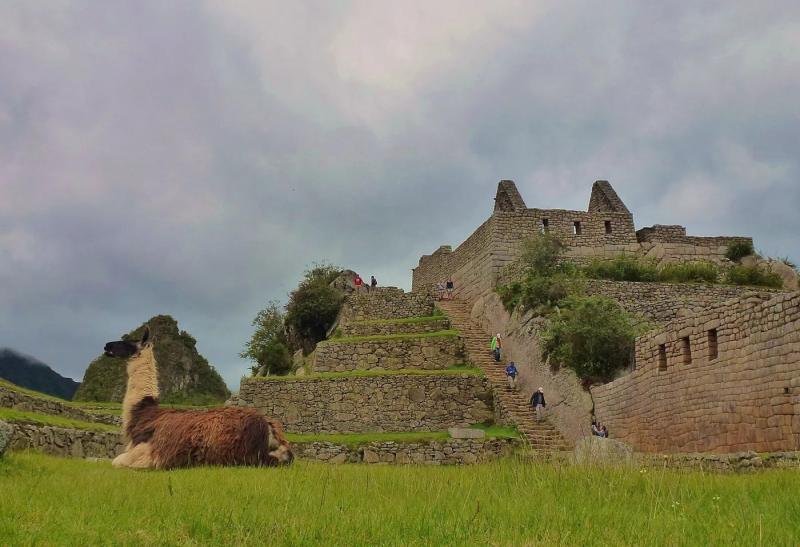
From May to September the rain drops below 3 in (76 mm) a month and most days start clear. The mornings are cold in Cusco, often near freezing, but Machu Picchu itself wakes up around 50°F (10°C) and climbs past 70°F (21°C) by noon. The light is hard and the sky is blue, which is what the postcard shows.
The mistake is packing for the dry season as if it were summer. The citadel is in a gorge, and when the sun drops behind Machu Picchu Mountain the air cools fast. People shiver on the 5:50 p.m. train in a T-shirt. Bring a fleece and a shell even in July, and sunscreen and a hat for the hours in between, since the sun at this altitude burns in twenty minutes.
Our pick inside the dry season is May, and then September. In May the terraces are still green from the rains, the Inca Trail has been open for two months, and the June crowds have not arrived. In September the first afternoon showers return but the mornings stay clear, and the daily cap is still 5,600, so the routes feel less tight than in July. If you must travel in July or August, book the entry ticket and the train three months ahead and take the first bus up.
Green season: November to April
From November to April the afternoon rain is a daily event and the mountains are at their greenest. January, February and March each average about 13 in (325 to 341 mm) of rain, which is the figure to respect. It does not rain all day. The pattern is a damp morning, cloud sitting on the peaks, a clearing around mid-morning, then a hard shower in the afternoon. The daily limit drops to 4,500 and the circuits are quiet.
What people get wrong is the cloud, not the rain. In the wet months the citadel often sits inside the cloud until 9:00 or 10:00 a.m. Travelers who insist on the 6:00 a.m. slot in January can walk Circuit 2 inside a white room. Book a mid-morning entry instead, and bring a rain shell rather than an umbrella, which the park bans. For the full list of banned items, see our guide to the Machu Picchu circuits.
Two logistics change in the wet months. PeruRail usually closes Poroy station from January to April and replaces the Cusco departures with its Bimodal Service, a bus from Wanchaq station to the Sacred Valley and the train from there, per perurail.com. And the Inca Trail closes for the whole of February, which the next section covers. December needs its own note: the first three weeks are quiet and green, then the 30th and 31st jump back to high-season capacity and the trains fill with holiday travelers.
The February closure of the Inca Trail
The Inca Trail network closes to visitors every February for maintenance and because of the rain. For the current year, SERNANP and the Dirección Desconcentrada de Cultura de Cusco closed routes 1, 2, 3, 5 and 6 of the network from 31 January to 28 February, with full operations resuming on 1 March (as of January 2026, Andina). That covers the Classic 4-day trail and the Short 2-day trail.
Machu Picchu itself stays open in February. Trains run, the bus runs and the circuits are at their quietest. If your dates are fixed in February and you want to walk in, the Salkantay trek and the Lares trek do not use the Inca Trail network and keep running, with a bus or train to the citadel on the last day. For how the permits work in the other eleven months, read our Inca Trail permits guide.
Sunrise at Machu Picchu
Sunrise over the citadel is not what the photos suggest. The sun rises between about 5:13 a.m. in November and 6:13 a.m. in July (sunrise times compiled by New Peruvian), but the site is ringed by ridges, so first light reaches the terraces in a gray half-light and the direct sun arrives up to an hour later. The gate opens at 6:00 a.m. and the first buses leave Aguas Calientes around 5:30 a.m., so you are in the queue before dawn and inside while the light is flat.
The early slot is still worth taking, for a different reason. Between 6:00 and 8:00 a.m. the circuits hold the fewest people of the day, and in the dry season the moment the sun clears the eastern ridge and lights the Temple of the Sun is the photograph you came for. In the wet season the show is the cloud lifting off Huayna Picchu, which happens at no fixed hour. Either way you need a night in Aguas Calientes, because no train from Cusco or the Sacred Valley arrives before mid-morning. Our Aguas Calientes guide explains the town and the bus line.
Our pick by type of traveler
For a first visit with photos as the priority, May or September. For a trek, May, June or September, when the passes are dry and the Inca Trail permits are easier than in July. For a tight budget, November or the first three weeks of December, when the trains and hotels have seats and rooms and the hills are green. For families on school holidays, July works, with everything booked three months ahead. For travelers who hate crowds more than rain, January or March, with a mid-morning entry slot.
Whatever the month, the sequence does not change: entry ticket first, train second, hotel third. Our Machu Picchu tours by season handle that order for you, with the morning train and a licensed guide inside the circuits, and the 2-day version adds the night in town that makes the early slot possible. The entry ticket rules by hour and route are in our Machu Picchu tickets guide.
Questions people ask
What is the rainy season at Machu Picchu?
November to April, with the heaviest rain from January to March, when the SENAMHI normals show about 13 in (325 to 341 mm) a month. Rain usually comes as cloud in the morning and a shower in the afternoon rather than all-day downpours. The daily visitor limit drops to 4,500 in those months, the trails are muddy and the terraces are at their greenest.
Is the Inca Trail closed in February?
Yes. The park authorities close the Inca Trail network every February for maintenance, and for the current year the closure ran from 31 January to 28 February with reopening on 1 March (as of January 2026, Andina). Machu Picchu itself, the trains and the Salkantay and Lares treks stay open.
Which month has the clearest skies at Machu Picchu?
June and July, with about 2 in (51 to 54 mm) of rain in the SENAMHI normals and the lowest cloud cover of the year. They are also the busiest months, with the 5,600-a-day cap in force and July the peak. May and September give almost the same mornings with fewer people, which is why they are our pick for photographs.
What is Machu Picchu like in December?
Green, warm and wet, with about 10.8 in (275 mm) of rain and nights near 54°F (12°C). The first three weeks are quiet, with the 4,500 daily limit and easy tickets. On 30 and 31 December the capacity rises to 5,600 and holiday travelers fill the trains and hotels, so book those two days as you would July.
How is the weather at Machu Picchu in July?
The driest and coldest month: about 2.1 in (54 mm) of rain, highs near 72°F (22°C) and nights near 49°F (9.4°C), with frost possible in Cusco. It is also the peak of the year for visitors. Buy your entry slot and train seats three months ahead, take the first bus up and carry a fleece for the evening train back.
Can you see the sunrise at Machu Picchu?
Not a true sunrise. Sunrise falls between about 5:13 a.m. in November and 6:13 a.m. in July, but the ridges around the citadel hide it, and direct light reaches the terraces up to an hour later. The gate opens at 6:00 a.m., so a 6:00 slot with a night in Aguas Calientes puts you inside for the first light and the emptiest circuits.
Sources
- SENAMHI climate normals 1991 to 2020 for Machu Picchu, as reproduced in the Wikipedia climate table checked October 2026
- Andina, Machu Picchu 2026 ticket rates and visitor limits (RM 000284-2025-MC and 000285-2025-MC) checked October 2026
- Andina, Inca Trail sections closed to tourists in February (SERNANP) checked October 2026
- Ministerio de Cultura, Machu Picchu entry hours table checked October 2026
- Ministerio de Cultura, code of conduct (umbrellas banned) checked October 2026
- PeruRail, Bimodal Service (January to April) checked October 2026
- New Peruvian, Machu Picchu sunrise times checked October 2026
- tuboleto.cultura.pe, Llaqta de Machupicchu (altitude 2,430 m) checked October 2026
This guide was last reviewed in October 2026. Prices, rules and timetables are quoted with the date we checked them.