



Inca Trail Permits: How They Work and When They Sell Out
You cannot buy an Inca Trail permit yourself. Licensed tour operators book it in your name and passport number, with a cap of 500 people a day on the classic routes, staff included. The trail closes every February. For May to August, book when the season opens, typically months ahead.

In this guide
- What an Inca Trail permit covers
- Who can book a permit
- Daily caps and how they fill
- When permits go on sale
- Availability by month
- The February closure
- Names, passports and the no-transfer rule
- Best time to hike the Inca Trail
- Routes in the Inca Trail network
- When the permits are gone
- Questions people ask
- Sources
Short answer: You cannot buy an Inca Trail permit yourself. Permits are sold only through licensed tour operators, issued in your name and passport number, and capped at 500 people a day on the classic routes, porters and guides included. The trail closes every February. For May to August, book as soon as the season opens, typically months ahead.
| Item | Detail | Source |
|---|---|---|
| Who can book | Only licensed travel agencies with a SERNANP service contract | Reglamento, art. 9 |
| Guide | Official tour guide designated by the agency, mandatory | Reglamento, art. 15 and 16 |
| Daily cap, routes 1 to 4 | 500 users a day, staff included | Reglamento, art. 14 |
| Daily cap, route 5 (KM 104) | 250 users a day | Reglamento, art. 14, DDC Cusco 2026 opening |
| Hikers among the 500 | About 200 (industry estimate, not official) | Operators |
| Closure | Every February | Reglamento, art. 10, DDC Cusco notice |
| 2026 sale opening | 17 November 2025, 8:00 a.m., January dates first | DDC Cusco, 17 November 2025 |
| Payment after reserving | Within 3 hours or cancelled | Reglamento, art. 19 |
| Final traveler list | Up to 48 hours before the start | Reglamento, art. 19 |
| Transfers and refunds | Nominal, non-transferable, no refund for no-shows | Reglamento, art. 20 to 22 |
| Trail hours | Entry 5:00 a.m. to 2:00 p.m., no walking 6:00 p.m. to 5:00 a.m. | Reglamento, art. 9 |
That last point is the one that costs people their trek. The permit is the bottleneck, not the hike. If the Classic Inca Trail is the reason you are going to Peru, lock it in first and build the rest around it: our Classic Inca Trail 4 days, permit included books the permit under your passport as part of the trip, through the partner operator authorized by SERNANP that runs the trek for us. Then read on for how the system works, so you know what you are signing up for.
What an Inca Trail permit covers
An Inca Trail permit is a named entry ticket to the Inca Trail network (Red de Caminos Inka) inside the Historic Sanctuary of Machu Picchu, valid for one route and one start date. It also includes your visit to the Machu Picchu citadel at the end of the route. Without it, the checkpoint at the trailhead turns you back, and there is no ticket office to fix that on the spot.
Two public bodies run the network. SERNANP, Peru's protected-areas service, manages the sanctuary as a natural area. The Ministerio de Cultura, through its Cusco office (DDC Cusco), manages the archaeological sites and sells the entries. Their joint rulebook is the Reglamento de Uso Turístico Sostenible de la Red de Caminos Inka, and most of what follows comes from it.
Who can book a permit
Only licensed travel agencies with a service contract signed with SERNANP can book Inca Trail permits, and every group must walk with an official tour guide designated by the agency. The regulation says tourist use of the network happens in an organized way through those agencies. Independent hiking is not allowed on the Classic Inca Trail.
In practice, the agency registers each traveler in the DDC Cusco system, pays within 3 hours of reserving (or the reservation is cancelled automatically), and submits the final traveler list up to 48 hours before the start date. That is why the first thing an operator asks for is your passport. Treat any website that offers a permit without asking for your passport data with suspicion.
Daily caps and how they fill
The regulation sets a capacity of 500 users a day on routes 1 to 4 and 250 a day on route 5 (the short trail from KM 104). For the 2026 season, DDC Cusco confirmed 500 daily spaces on each of routes 1, 2 and 3 and 250 on route 5. The 500 count everyone on the trail: hikers, guides, cooks and porters. Operators commonly estimate that leaves around 200 spaces for hikers, a figure that is not official but matches what we see.
Spaces go per day, not per operator. When a date fills, it is gone for every agency at once. A permit booked by an agency for a group cannot be reassigned to another traveler, so there is no secondhand market to wait for. The table below shows the routes defined by the regulation.
When permits go on sale
Permits for the following season typically go on sale in the last months of the year before, on a date DDC Cusco announces a few weeks ahead. For the 2026 season, reservations opened on 17 November 2025 at 8:00 a.m. for the Inca Trail, starting with the month of January, according to DDC Cusco. Peruvian radio network RPP reported that the opening was moved earlier than the usual December date. Expect the date to shift from year to year, and check our availability table or your operator in September.
Opening day matters only for the busiest dates. The first wave of agency reservations targets May to August, Easter and the long weekends. If you want a Saturday start in June, send your passport data to your operator before the opening, so the reservation goes in on the first morning.
Availability by month
From May to August, permits for most dates sell out months ahead, and the late-May and June dates around Inti Raymi go first. April, September and October fill more slowly. January, March, November and December usually have spaces a few weeks out, because they fall in the rainy season. February has no permits at all.
| Start month | Classic trail (route 1) | Short trail (route 5) | Weather |
|---|---|---|---|
| January | 3 to 6 weeks | 2 to 4 weeks | Wettest open month |
| February | Closed | Closed | Network closed for maintenance |
| March | 1 to 2 months | 3 to 6 weeks | Rain easing late in the month |
| April | 3 to 4 months | 1 to 2 months | Green, some showers |
| May | 6 months or more | 2 to 3 months | Dry, clear, cold nights |
| June | 6 months or more, on opening day for Inti Raymi week | 3 months | Dry, coldest nights |
| July | 6 months or more | 3 months | Dry, busiest month |
| August | 6 months or more | 2 to 3 months | Dry, windy |
| September | 3 to 5 months | 1 to 2 months | Dry, warming |
| October | 2 to 4 months | 1 month | First rains |
| November | 1 to 2 months | 3 to 4 weeks | Showers most afternoons |
| December | 1 to 2 months, more for the holidays | 3 to 4 weeks | Rainy |
The timing table below is our planning rule from booking the trail, not an official figure. Real availability changes daily. A licensed operator can check the live count in the DDC Cusco system for your exact date.
The February closure
The Inca Trail network closes every February, by rule. Article 10 of the regulation sets the closure for natural recovery of the ecosystem and maintenance of the heritage and its facilities. DDC Cusco confirms the dates each January. During the month, crews clear vegetation from the Inca walls, repair stone steps and bridges, and rebuild the campsites at Pacaymayo, Phuyupatamarca and Wiñay Wayna.
Machu Picchu itself stays open in February. A train tour still works, and so do treks that do not use the Inca Trail network, such as Salkantay to Santa Teresa or Lares. Expect heavy afternoon rain on any of them.
Names, passports and the no-transfer rule
The permit is nominal, personal and non-transferable, valid only for the route and date booked, per Article 22 of the regulation. Foreign hikers must identify themselves with their passport at the checkpoints. The name and passport number on the permit have to match the document you carry.
- Send your operator a clear photo of your passport data page, not a typed copy. Most errors come from retyping.
- If you plan to renew your passport before the trip, renew first and book with the new number.
- If you renew after booking, tell your operator the same day and carry both passports.
- DDC Cusco decides whether a passport number can be updated on the permit, so a fix is never guaranteed.
- A permit cannot be moved to a friend or a different date. A traveler who does not show up loses the full entry fee, per Article 21.
Agencies can cancel spaces up to 48 hours before the start, without a refund of the entry, and the cancelled spaces cannot be used again. That is why operators' cancellation terms for the permit portion are strict. Read them before you pay the deposit.
Best time to hike the Inca Trail
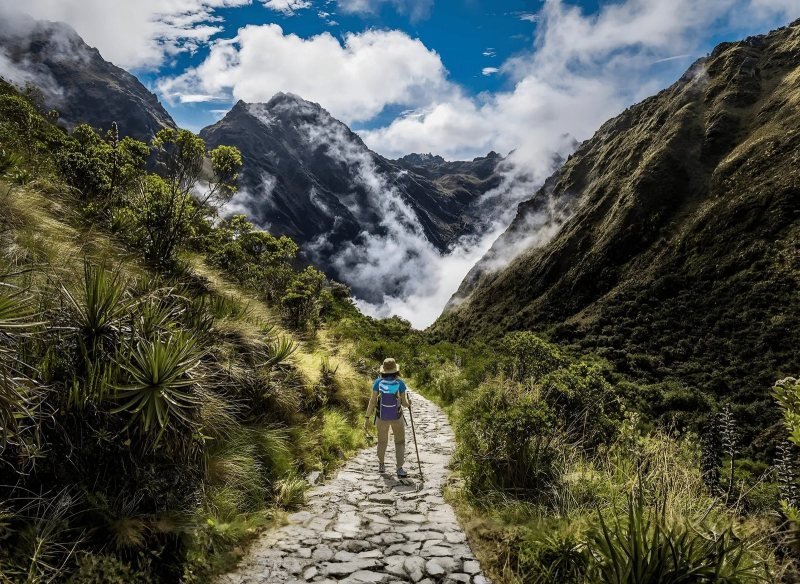
The best months to hike are May to September, the dry season in the Andes, with clear mornings and cold nights near freezing at the high camps. Our pick is May or September: the weather is close to July's and the permits are a little easier to get. April and October are greener, with some afternoon showers. January and March are the wettest open months, and the stone steps turn slick.
Routes in the Inca Trail network
The regulation defines six routes. Most hikers mean route 1 when they say "the Inca Trail". Route 5 is the short version, often sold as the 1-day or 2-day Inca Trail, and it has its own quota of 250 a day. Route 6 is listed in the regulation but, per the Ministerio de Cultura's 2026 sale announcement, still needs technical coordination before it opens.
| Route | Start | Length of stay | Daily cap (people) | Notes |
|---|---|---|---|---|
| Route 1 | Piscacucho (KM 82) | 4 days, 3 nights | 500 | The Classic Inca Trail via Wayllabamba and Wiñay Wayna |
| Route 2 | Qorihuayrachina (KM 88) | 4 days, 3 nights | 500 | Starts a little further down the valley |
| Route 3 | Soraypampa | 6 days, 5 nights | 500 | Salkantay joining the Inca Trail, needs a permit |
| Route 4 | Piscacucho (KM 82) | 4 days, 3 nights | 500 | Via Pacaymayo Bajo and Chachabamba (KM 104) |
| Route 5 | Chachabamba (KM 104) | Direct access, 1 day on the trail | 250 | The short Inca Trail, guide with up to 4 hikers, no porters |
| Route 6 | Paucarcancha | Direct access | Not set | Listed in the regulation, not yet opened per the 2026 announcement |
When the permits are gone
A sold-out Inca Trail does not mean no trek to Machu Picchu. The alternatives below need no Inca Trail permit (except the short trail), and some of them are, in our view, better walks.
Salkantay Trek
Five days over the 4,630 m (15,190 ft) Salkantay Pass, down through cloud forest to Aguas Calientes, with no permit and no daily cap. It is higher and longer than the Classic Inca Trail, with fewer ruins and bigger mountains. Read the Salkantay trek guide for the day-by-day route.
Short Inca Trail from KM 104
Route 5 starts at Chachabamba, KM 104 of the railway, and climbs past Wiñay Wayna to the Sun Gate in about 12 km (7.5 mi). It needs a permit, but from a separate quota of 250 a day, so it often has room when the classic trail does not. You get Wiñay Wayna, to us the finest ruin on the trail, and the Sun Gate arrival in one day.
Lares Trek
Four days through Quechua weaving villages and high passes, then the train to Aguas Calientes. No permit, small groups, and more contact with village life than on any other route. Compare these and other options among our treks from Cusco.
Not sure which to choose? Our Salkantay versus Inca Trail comparison sets the two side by side on altitude, distance and effort.
Questions people ask
Do you need a guide for the Inca Trail?
Yes. Hiking the Inca Trail network without a guide is not allowed. The regulation says tourist use happens through licensed travel agencies, and each group walks with an official tour guide the agency designates. The guide's name is on the group's paperwork at the checkpoint. Your operator also supplies the cooks and porters for the multi-day routes.
When do Inca Trail permits go on sale?
Typically in the last months of the previous year, on a date DDC Cusco announces. For the 2026 season, DDC Cusco opened Inca Trail reservations on 17 November 2025 at 8:00 a.m., starting with January dates. Licensed agencies book on opening day for their travelers, so get your passport data to your operator before then.
How many people can start the Inca Trail daily?
The regulation caps routes 1 to 4 at 500 users a day and route 5, the short trail from KM 104, at 250. The 500 include guides, cooks and porters, so operators estimate that roughly 200 are hikers. That split is an industry estimate, not an official figure. Each date sells out for every agency at once.
Is the Inca Trail closed in February?
Yes, every February. Article 10 of the network's regulation closes it for the whole month for ecosystem recovery and maintenance, and DDC Cusco announces the dates each year. Machu Picchu stays open, so you can still visit by train, or hike Salkantay or Lares, which do not use the Inca Trail network.
Can I transfer my Inca Trail permit to someone else?
No. The permit is nominal, personal and non-transferable, valid only for the route and date booked. A no-show loses the full entry fee, and spaces an agency cancels cannot be resold. If your passport changes after booking, tell your operator at once and carry both passports.
How far in advance should I book the Inca Trail?
For May to August, book on or soon after the day sales open, which for popular dates means 6 months or more ahead. For April, September and October, two to four months usually works. In the rainy months a few weeks is usually enough. These lead times are our planning rule, and your operator can check live spaces for your date.
Sources
- SERNANP and DDC Cusco, Reglamento de Uso Turístico Sostenible de la Red de Caminos Inka del Santuario Histórico de Machupicchu checked October 2026
- DDC Cusco, Con proceso público y transparente se inició la venta de entradas para la Llaqta de Machupicchu y para la Red de Caminos Inka 2026 (17 November 2025) checked October 2026
- DDC Cusco, Cierre de la Red de Caminos Inka de Machupicchu en febrero (29 January 2025) checked October 2026
- RPP, Inició el proceso de venta de boletos de ingreso a la Red de Caminos Inka y a la Llaqta para 2026 checked October 2026
- Infobae, Desde el 17 de noviembre inicia la venta de boletos a Machu Picchu y camino inca para el 2026 checked October 2026
- La República, Ministerio de Cultura habilita la compra de entradas para Machu Picchu y el Camino Inca 2026 checked October 2026
- Tu Boleto, Ministerio de Cultura (official sales platform) checked October 2026
This guide was last reviewed in October 2026. Prices, rules and timetables are quoted with the date we checked them.