


Machu Picchu Circuits and Routes: Which One to Book
Machu Picchu has 3 circuits and 10 one-way routes, set by the Ministerio de Cultura. For a first visit, book Circuit 2 and take route 2-B if it has space: it stops at the lower platform with the classic view, then crosses the temples. Circuit 1 stays above the city. Circuit 3 leads to Huayna Picchu.

In this guide
Short answer: Machu Picchu has 3 circuits and 10 one-way routes, in force since 1 June 2024 under Ministerial Resolution 528-2023-MC. For a first visit, book Circuit 2. Take route 2-B if it has space, since it stops at the lower platform with the classic view before it crosses the temples. Circuit 1 stays above the city, and Circuit 3 leads to Huayna Picchu.
A circuit is one of the three official paths through the Inca city (the llaqta, in the Ministerio de Cultura's word), and each circuit splits into routes with their own ticket. The route printed on your ticket is the only one you walk that day. Guards at the control posts check it, and you cannot switch once you are through the gate.
We send travelers through these paths every week, and the question is always the same: which ticket shows me the real Machu Picchu? This guide answers it route by route, from the official maps. If you still need to buy the ticket itself, our step-by-step guide to Machu Picchu tickets covers the purchase, the prices and the time slots.
How the circuits work
The circuits work like one-way streets. You enter at the main gate at the hour on your ticket, follow arrows along a fixed loop, and leave by the exit beside the entrance. There is no walking back against the flow to retake a photo, so tell your guide in advance where you want to stop.
Along each route the Ministerio de Cultura marks explanation areas, the stops where groups can halt and guides can talk. Between them, staff keep people moving on the narrow paths. Each route also has a maximum time inside, from 2 hours 30 minutes on the plain city routes to 7 hours on the longest mountain and cave routes. The time is printed on the official route maps, and it is generous for the plain routes. Most guided visits on Circuit 2 run close to the full 2 hours 30 minutes.
The three circuits divide the site by height. Circuit 1, the Panoramic circuit (Circuito Panorámico), stays on the high agricultural terraces above the city. Circuit 2, the Machu Picchu Classic circuit (Machupicchu Clásico), walks through the urban sectors. Circuit 3, the Royalty circuit (Machupicchu Realeza), covers the lower half of the city and leads to three side trails.
Which circuit to book
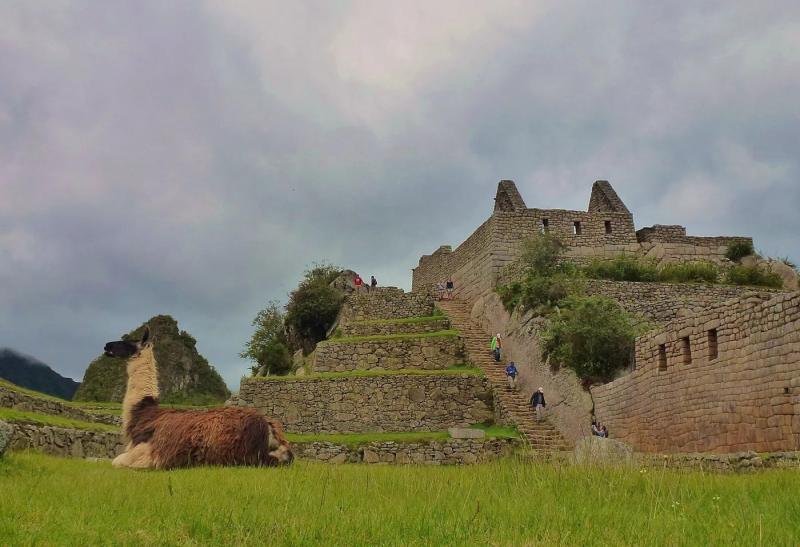
Circuit 2 is the circuit we book for first-time visitors, and it is the one our guides prefer to explain. It passes the Temple of the Sun viewpoint, the Plaza of the Temples, the Intiwatana, the Sacred Rock and the Temple of the Condor, per the official route maps. Those are the places the site is famous for.
| Circuit | Routes | Where it goes | Classic view | Main temples | Who it suits |
|---|---|---|---|---|---|
| Circuit 1, Panoramic | 1-A, 1-B, 1-C, 1-D | High terraces above the city, then side trails | Yes, from the upper platform | No, never enters the city | Photographers and hikers, as a second ticket |
| Circuit 2, Machu Picchu Classic | 2-A, 2-B | Through the urban sectors | Route 2-B, from the lower platform | Yes: Temple of the Sun viewpoint, Plaza of the Temples, Intiwatana, Sacred Rock, Temple of the Condor | Every first-time visitor |
| Circuit 3, Royalty | 3-A, 3-B, 3-C, 3-D | Lower half of the city, then side trails from the Sacred Rock | No | Partly: Temple of the Condor, water mirrors, Sacred Rock | Huayna Picchu climbers and repeat visitors |
Between its two routes, we pick 2-B when it has space. On the official map, route 2-B first climbs to the lower platform (Plataforma Inferior), an explanation area with the classic view of the city and Huayna Picchu behind it. Route 2-A skips that platform and covers the same temples. Both allow 2 hours 30 minutes inside.
The postcard view has a second, higher vantage point: the upper platform (Plataforma Superior). Only the Circuit 1 routes reach it. Route 1-B goes up there and comes back down without entering the city at all. People buy 1-B because it is available or cheap, then find out they never walked among the buildings. If you want the highest photo and the temples, buy two tickets for the same day, a Circuit 1 route and a Circuit 2 route at different hours.
Circuit 3 makes sense for two kinds of traveler: people climbing Huayna Picchu (route 3-A) and people back for a second visit who want the quieter lower sectors. Route 3-B is the plain version, through the Temple of the Condor, the storehouses and the water mirrors, with 2 hours 30 minutes inside.
Map of the circuits
The map below shows the three circuits on one plan, with the entrance, the exit, the control posts for the side trails and the explanation areas. It is redrawn from the ten route maps the Ministerio de Cultura publishes on machupicchu.gob.pe, which remain the official reference. Huayna Picchu sits at the far end of the plan, and the entrance at the near end.
Three details from the official maps help on the day. The only restrooms are outside the gate, next to the bus stop and the snack bar. The side trails to Huayna Picchu, Huchuy Picchu and the Great Cavern all leave from a control post by the Sacred Rock, at the far end of the city. The trails to Machu Picchu Mountain, the Sun Gate and the Inca Bridge leave from control posts on the high terraces.
The 10 routes in one table
Each route is a separate ticket with its own maximum time inside, from 2 hours 30 minutes to 7 hours, per the Ministerio de Cultura's route maps. Four routes are sold only in high season: 1-C (Sun Gate), 1-D (Inca Bridge), 3-C (Great Cavern) and 3-D (Huchuy Picchu). The table adds our view of who each route suits.
| Route | Official name | Max time inside | Extra walk or climb | Season | Our take |
|---|---|---|---|---|---|
| 1-A | Machu Picchu Mountain | 7 hours | Long stone stair climb to the summit | All year | Fit hikers who want the big view and fewer people |
| 1-B | Upper terrace | 2 hours 30 minutes | None | All year | Only as a second ticket, it never enters the city |
| 1-C | Intipunku (Sun Gate) | 4 hours | About 1 hour up on the Inca Trail | High season only | A real hike without exposure |
| 1-D | Inca Bridge (Puente Inka) | 3 hours | Mostly flat cliff path | High season only | Short and easy, no summit to climb |
| 2-A | Designed route | 2 hours 30 minutes | None | All year | First visit, if 2-B is full |
| 2-B | Lower terrace | 2 hours 30 minutes | Short climb to the lower platform | All year | First visit, our pick |
| 3-A | Huayna Picchu (Waynapicchu) | 6 hours | Steep, exposed stairs to the peak | All year | Climbers with no fear of heights |
| 3-B | Designed route | 2 hours 30 minutes | None | All year | Second visit, quieter lower sectors |
| 3-C | Great Cavern | 7 hours | Long trail down and around to the Temple of the Moon | High season only | Repeat visitors with a full day |
| 3-D | Huchuy Picchu | 3 hours 30 minutes | Short, steep climb to a small peak | High season only | A taste of a summit in little time |
The three summit routes (1-A, 3-A and 3-D) put a second time on the ticket, the hour you must reach the mountain checkpoint, and that checkpoint gives no tolerance at all. Our comparison of Huayna Picchu and Machu Picchu Mountain covers the climbs in detail.
Inca Bridge and Sun Gate
The Inca Bridge (Puente Inka, route 1-D) and the Sun Gate (Intipunku, route 1-C) are the two easy side walks of Circuit 1. Both start on the high terraces, both are sold only in high season, and neither enters the city.
Route 1-D, the Inca Bridge
Route 1-D follows a narrow path cut into the west face of the mountain, with a long drop on one side, to a gap in an Inca road that was crossed on removable logs. You see the bridge from a fenced viewpoint at the end of the path. You do not cross it. The walk is mostly flat, and the route allows 3 hours inside, which is plenty.
Do not confuse it with Q'eswachaka, the woven grass rope bridge over the Apurímac River, a day trip south of Cusco that local communities rebuild every June. Searches for "Inca rope bridge" mix the two up, and they are about four hours apart by road.
Route 1-C, the Sun Gate
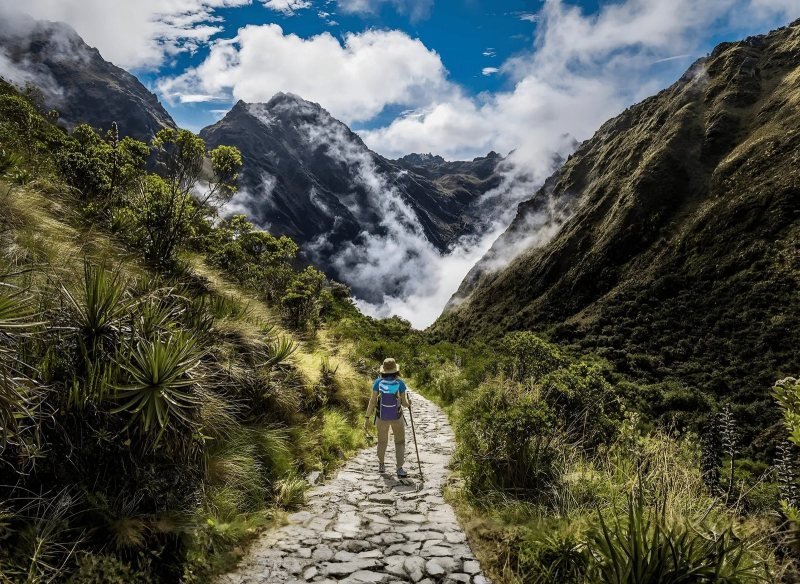
Route 1-C climbs from the upper terraces along the last stretch of the Inca Trail to Intipunku, the stone gateway where trekkers first see the city. Allow about an hour up on uneven stone steps, and the route allows 4 hours inside. The view looks down the whole length of Machu Picchu with Huayna Picchu behind, and the climb is steady without the exposure of the summit trails.
Our take: 1-C is the right extra for travelers who want a real hike but dislike heights. It also has fewer people than the city routes, since most visitors never leave the circuits.
Sunrise and timing
The first entry slot is 6:00 a.m., per the Ministerio de Cultura's entry-hours table, and the first buses leave Aguas Calientes before that. To be in the first slot you have to sleep in Aguas Calientes the night before, because no train from Cusco or the Sacred Valley arrives that early.
Set your expectations for sunrise. The sun clears the eastern ridges some time after the gates open, and in the rainy months, roughly November to March, the city often sits in cloud until mid-morning. The early slot is worth it for the cool air and the thin crowds, and on many days the cloud lifting off Huayna Picchu is the show. Our 2-day tour with an early entry is built around that night in town.
Rules inside the circuits
The rules inside come from the Ministerio de Cultura's code of conduct, plus the logic of the one-way circuits. Guards and national police enforce them, and breaking them means removal without a refund.
- Stay on the route printed on your ticket and walk in the direction of the arrows.
- Stop to talk and explain only in the marked explanation areas, not on narrow paths.
- Do not climb on walls, sit on structures or touch and move stones.
- Carry a bag no larger than 40 by 35 by 20 cm (16 by 14 by 8 in).
- Leave walking sticks, umbrellas, tripods, selfie sticks and drones at your hotel.
- Do not bring food inside, and do not smoke or vape.
- Keep your passport and ticket with you until you leave.
Plan for a single entry. The routes are drawn as loops that end at the exit, and we have not found an official rule that lets you go back in on the same ticket. Use the restrooms outside the gate before your slot. The full list of banned items is in our Machu Picchu tickets guide.
Letting someone else pick the route
Choosing the circuit is the easy part. Getting a 2-B ticket for the hour your train allows, in the month you travel, is the hard part. Our tours that book Circuit 2 for you buy the ticket under your passport and match the train, the bus and a licensed guide to your entry hour. If you are still working out the trains, start with how to get to Machu Picchu from Cusco.
Questions people ask
Which Machu Picchu circuit has the classic postcard view?
Book Circuit 2 for it. Route 2-B starts at the lower platform, where you look across the whole city to Huayna Picchu, and then walks through the temples. Circuit 1 reaches the higher upper platform for the same scene from above, but its routes never enter the city. For both angles, buy one ticket of each.
Circuit 2-A or 2-B: what is the difference?
Both routes of Circuit 2 cross the same sectors, from the viewpoint over the Temple of the Sun to the Intiwatana pyramid, the carved Sacred Rock and the Condor temple. Route 2-B adds a first stop at the lower platform, the spot for the classic photo. Both allow 2 hours 30 minutes inside, per the official route maps. Take 2-B when it has space.
What is route 1-D, the Inca Bridge?
Route 1-D is a Circuit 1 ticket that adds a walk on a narrow cliff path to the Inca Bridge (Puente Inka), where the Incas left a break in the trail and spanned it with logs. You see it from a fenced viewpoint. The route is sold only in high season, allows 3 hours inside, and does not enter the city.
Can you re-enter Machu Picchu on the same ticket?
Plan on one entry. Each route is a one-way loop that finishes where it started, and no official rule we found allows a second entry on the same ticket. The restrooms are outside the gate, so use them before your slot. If you want more time, buy a second ticket for another route and hour.
How long can you stay on each route?
The plain city routes (1-B, 2-A, 2-B and 3-B) allow 2 hours 30 minutes. The side trails allow more: 3 hours for the Inca Bridge, 3 hours 30 minutes for Huchuy Picchu, 4 hours for the Sun Gate, 6 hours for Huayna Picchu, and 7 hours for Machu Picchu Mountain and the Great Cavern, according to the official maps of each route.
Can you see sunrise at Machu Picchu?
Gates open at 6:00 a.m., so you only get there early by sleeping in Aguas Calientes and taking one of the first buses. Direct sun reaches the ruins only after opening time, and from November to March the city is often in cloud early on. Go for the cool air and the quiet, and treat a clear sunrise as a bonus.
Sources
- machupicchu.gob.pe, Circuits and routes (RM 528-2023-MC) checked October 2026
- Ministerio de Cultura, route map 1-A, Machu Picchu Mountain (PDF) checked October 2026
- Ministerio de Cultura, route map 1-B, upper terrace (PDF) checked October 2026
- Ministerio de Cultura, route map 2-A, designed route (PDF) checked October 2026
- Ministerio de Cultura, route map 2-B, lower terrace (PDF) checked October 2026
- Ministerio de Cultura, route map 3-A, Waynapicchu (PDF) checked October 2026
- Ministerio de Cultura, DDC Cusco, Horarios de ingreso (entry hours and tolerance, PDF) checked October 2026
- machupicchu.gob.pe, Code of conduct checked October 2026
- Ministerio de Cultura, Tu Boleto: Llaqta de Machupicchu checked September 2026
This guide was last reviewed in October 2026. Prices, rules and timetables are quoted with the date we checked them.