


Sacred Valley Guide: Pisac to Ollantaytambo, Stop by Stop
The Sacred Valley is the Urubamba River valley between Pisac and Ollantaytambo, 21 to 37 mi (33 to 60 km) north of Cusco and about 1,640 ft (500 m) lower. The things to do are five Inca sites and one market: Pisac, Ollantaytambo, Chinchero, Moray and the Maras salt pans. One long day covers three or four of them.

In this guide
Short answer: The Sacred Valley is the stretch of the Urubamba River between Pisac and Ollantaytambo, 21 to 37 mi (33 to 60 km) north of Cusco and about 1,640 ft (500 m) lower than the city. The things to do are five Inca sites and one market: the Pisac terraces and market, the Ollantaytambo fortress, the weaving town of Chinchero, the round terraces of Moray and the Maras salt pans. One long day from Cusco covers three or four of them. Pisac, Ollantaytambo, Chinchero and Moray open with the Boleto Turístico del Cusco (Circuit III, S/70 for foreign adults, valid two days, as of August 2026 per COSITUC). Maras charges its own entry in cash.
What the Sacred Valley is and where it sits
The Sacred Valley of the Incas (Valle Sagrado) is the farming valley of the Urubamba River, about 37 mi (60 km) long, between the town of Pisac at the eastern end and Ollantaytambo at the western end. The valley floor sits near 9,416 ft (2,870 m) at Urubamba, against 11,150 ft (3,400 m) in Cusco. The Incas terraced its slopes for corn, built their estates along the river and left the fortress of Ollantaytambo guarding the way down toward Machu Picchu. The train to Aguas Calientes still leaves from there.
Two things make the valley easy to plan around. It is lower than Cusco, so your body gets a break on the day you visit. And it lies on the road to Machu Picchu, so the sites are stops on the way, not a detour. The mistake most people make is to loop back to Cusco and drive out again the next morning for the train.
The valley on a map, east to west
Read the valley from right to left along the river. Pisac is closest to Cusco, about an hour by road over the pass and down the switchbacks. Calca and Urubamba are the farming towns in the middle, where the tour buses stop for lunch and where the lodges with gardens are. Ollantaytambo is at the far end, 1 hour 45 minutes to 2 hours from Cusco, where the valley narrows and the road ends at the train station.
Above the valley, on the plateau to the south, sit three more stops: Chinchero at 12,342 ft (3,762 m), Moray and the salt pans of Maras. The plateau is higher than Cusco, which is why a tour that includes Chinchero and Moray climbs first and drops to the valley floor for lunch. The table under the site descriptions gives the drive time, the ticket and the time you need at each one.
Site by site: time, ticket and reasons
| Site | Drive from Cusco | Ticket | Time needed | Why go |
|---|---|---|---|---|
| Pisac ruins and market | about 1 hour | Boleto Turístico (ruins), market free | 90 minutes ruins, 45 minutes market | curved terraces, the valley's biggest craft market |
| Urubamba | about 1 hour 15 minutes | none | lunch stop or a night | lowest altitude, lodges with gardens |
| Ollantaytambo | 1 hour 45 minutes to 2 hours | Boleto Turístico (fortress), Pinkuylluna free | 90 minutes fortress, 1 hour town | living Inca town, finest stonework, the train station |
| Chinchero | about 45 minutes | Boleto Turístico | 1 hour | weaving demonstration, church on Inca walls |
| Moray | about 1 hour 15 minutes | Boleto Turístico | 45 minutes | round terraces, the oddest Inca site in the valley |
| Maras salt pans | about 1 hour 20 minutes | own entry, cash | 45 minutes | about 3,000 white pools, the photograph everyone wants |
Pisac: the terraces and the market
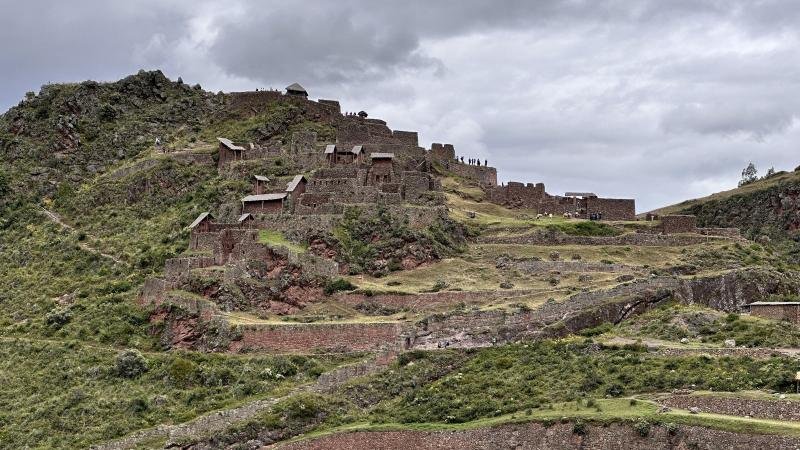
Pisac is two places. The archaeological park is a ridge of curved terraces, temples and lookouts about 20 minutes by road above the town, attributed to the emperor Pachacuti around 1440 and covering more than 65 hectares (160 acres). Give it 90 minutes with a guide, and expect uneven stone steps with no handrails. The town below, at 9,751 ft (2,972 m), has a craft market on the plaza daily, with official market days on Tuesday, Thursday and Sunday. Sunday is the big one, when Quechua families from the hills come down with produce and the stalls spill into the side streets.
Why go: the terraces are the most photogenic farming landscape in the valley, and the market is the easiest place to buy textiles directly from the maker. Bring soles in cash and bargain gently.
Urubamba and Calca: lunch and the lowest beds
Neither town has a site to visit. Urubamba is where the buffet lunches happen and where many of the valley lodges are, at the lowest altitude in the valley. If you want a slow night in the valley before Machu Picchu, this is the place to sleep. Our Sacred Valley hotel guide compares the towns by altitude and by walking time to the train.
Ollantaytambo: the fortress and the station
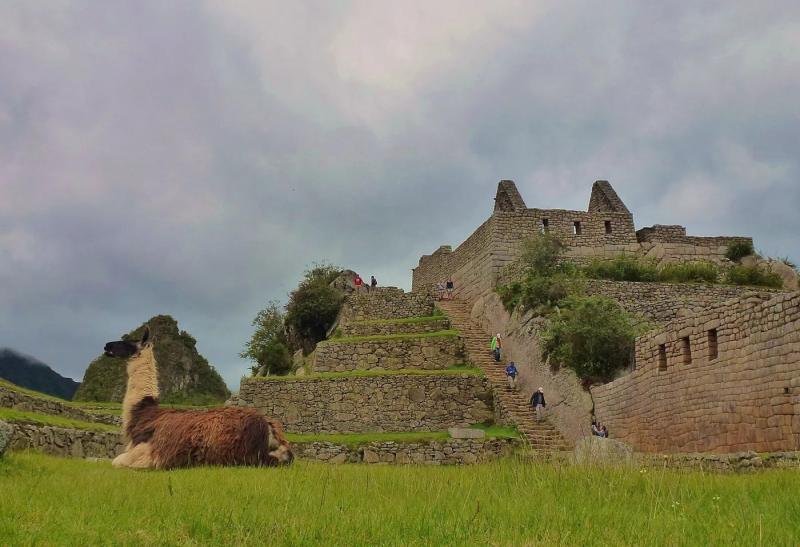
Ollantaytambo, at 9,160 ft (2,792 m), is the only town in Peru where people still live inside an Inca street grid, with water running in stone channels beside the lanes. The fortress climbs above the plaza in terraces, about 200 steps up to the Temple of the Sun, where six pink stone monoliths stand unfinished because the Spanish arrived before the builders were done. On the opposite hill, the storehouses of Pinkuylluna are a free 20-minute climb with the clearest view of the fortress. Give the fortress 90 minutes and the town another hour if you can. Our Ollantaytambo guide covers the site, the grid and the train station.
Why go: stonework as fine as Machu Picchu, a living Inca town, and the train. Every Machu Picchu trip passes through here whether you stop or not.
Chinchero: weavers on the plateau
Chinchero sits on the plateau at 12,342 ft (3,762 m), higher than Cusco, which is why it feels cold at 5 p.m. The colonial church of Nuestra Señora de la Natividad, built in 1607, stands on the walls of a palace of the Inca Túpac Yupanqui, and the plaza wall below it is Inca. The weaving cooperatives show how they wash wool with a root, dye it with cochineal and plants, and weave on a backstrap loom. Give it an hour. The craft market runs daily and fills up on Sunday.
Why go: the weaving demonstration is the one place on the circuit where you see a craft being made, not sold.
Moray: the round terraces
Moray is a set of concentric stone terraces sunk into natural bowls in the plateau, about 31 mi (50 km) from Cusco. The largest bowl is about 100 ft (30 m) deep, and the air at the bottom is noticeably warmer than at the rim. Many researchers think the Incas used it to test crops at different temperatures. Nobody has proved it. You walk the rim in about 45 minutes. It is on the Boleto Turístico.
Maras: the salt pans
The Maras salt pans (Salineras de Maras) are about 3,000 shallow pools in use on a hillside, fed by a salty spring and worked by families from the two local communities. In the dry season the pools are white, and in the rainy months they turn brown and the harvest pauses. Since 2019 visitors look from the paths and viewpoints at the top rather than walking among the pools, because of contamination of the salt. The site charges its own entry in cash, separate from the Boleto Turístico. Give it 45 minutes, and read our Maras and Moray guide for when the pools are whitest.
One day or overnight?
One day is enough to see the valley well if you choose a side. The classic loop takes Pisac, lunch in Urubamba, Ollantaytambo and Chinchero. The plateau loop takes Chinchero, Moray, Maras, lunch, Ollantaytambo and a late Pisac. Both run about 12 hours from Cusco. Our Sacred Valley day tour from Cusco is the classic loop with the Pisac market, and we recommend it on your second day in Peru because the valley is kinder to your body than the city.
Overnight is better if Machu Picchu is next. Sleep in Ollantaytambo or Urubamba, or ride the train the same evening and sleep in Aguas Calientes. Our Sacred Valley and Machu Picchu in 2 days does exactly that: Pisac, Urubamba and Ollantaytambo on day one, the late train, and the citadel with a guide the next morning. You never go back to Cusco in between.
How to get from Cusco to the Sacred Valley
By road, always. There is no train between Cusco and the valley towns except the Machu Picchu line, which stops in Ollantaytambo. A tour van from Cusco reaches Pisac in about an hour and Ollantaytambo in about two. Shared vans (colectivos) leave Cusco for Pisac, Urubamba and Ollantaytambo through the day and cost a few soles, and a taxi for the day is the other option if you want to set your own pace.
Altitude is the only health note. The valley floor is lower than Cusco, so a valley day is a good first full day after you land. Chinchero and Moray are higher than the city, so do them after at least one night in Cusco. Our Cusco altitude guide explains what to expect on the first two days.
| Fact | Value | Source |
|---|---|---|
| Where | Urubamba River valley between Pisac and Ollantaytambo, Cusco Region, Peru | en.wikipedia.org |
| Length | about 37 mi (60 km) from Pisac to Ollantaytambo | |
| Valley floor altitude | about 9,416 ft (2,870 m) at Urubamba, roughly 1,640 ft (500 m) below Cusco | |
| Plateau altitude | Chinchero 12,342 ft (3,762 m), Moray about 11,500 ft (3,500 m) | en.wikipedia.org |
| Drive from Cusco | Pisac about 1 hour (33 km, 21 mi), Ollantaytambo 1 hour 45 minutes to 2 hours (60 km, 37 mi) | |
| Ticket for Pisac, Ollantaytambo, Chinchero, Moray | Boleto Turístico del Cusco, Circuit III: S/70 foreign adults, 2 days. Full ticket S/130, 10 days (as of August 2026) | cosituccusco.pe |
| Maras salt pans | separate entry paid in cash at the site, not on the Boleto Turístico | en.wikipedia.org |
| Train to Machu Picchu | from Ollantaytambo station, 1.5 to 2 hours to Aguas Calientes | perurail.com |
Sources
- COSITUC, Boleto Turístico del Cusco, tarifario (circuits and prices, updated August 1, 2026)
- Písac, Wikipedia (altitude, area of the park, market days, Pachacuti)
- Ollantaytambo, Wikipedia (altitude, grid, Temple of the Sun)
- Moray, Wikipedia (depth, temperature difference, theories)
- Maras, Wikipedia (spring, cooperative, 2019 access rule)
- Dirección Desconcentrada de Cultura Cusco, Zona Arqueológica de Chinchero (Túpac Yupanqui, church of 1607)
Questions people ask
How do you get from Cusco to the Sacred Valley?
By road. A tour van or taxi gets to Pisac in roughly an hour and to Ollantaytambo in 1 hour 45 minutes to 2 hours. Shared vans leave Cusco for Pisac, Urubamba and Ollantaytambo through the day for a few soles. The only train in the valley is the Machu Picchu line from Ollantaytambo, so you cannot ride a train from Cusco to Pisac or Urubamba.
What are the Pisac market days?
The craft market on the Pisac plaza runs daily. Tuesday, Thursday and Sunday are the official market days, when produce stalls join the crafts. Sunday is the biggest, with Quechua families from the hill villages selling vegetables and grains and the stalls spilling into the side streets. If a Sunday fits your dates, make it the Pisac day.
What is the Sacred Valley?
The Sacred Valley is the Urubamba River's farming valley north of Cusco, between Pisac and Ollantaytambo. The Incas terraced it for corn, built royal estates along the river and fortified its western end at Ollantaytambo. Today it holds five of the main Inca sites near Cusco and the train station for Machu Picchu.
Where is the Sacred Valley in Peru?
In the Cusco Region of southern Peru, 21 to 37 mi (33 to 60 km) north and northwest of the city of Cusco, along the Urubamba River. Pisac marks the eastern end and Ollantaytambo the western end. Machu Picchu lies further down the same river, reached by train from Ollantaytambo.
Is one day enough for the Sacred Valley?
One day covers three or four sites well. Choose the classic loop (Pisac, Ollantaytambo, Chinchero) or the plateau loop (Chinchero, Moray, Maras, Ollantaytambo). Trying to see all five sites and the market in one day means 15 minutes at each and most of the day in a van. Two days, or one day plus the train to Machu Picchu that evening, is the better plan.
Should I sleep in the Sacred Valley before Machu Picchu?
Yes, if your schedule allows it. The valley floor is about 1,640 ft (500 m) lower than Cusco, so you sleep better, and the train leaves from Ollantaytambo, so the morning is short. The other good option is to take the late train the same day and sleep in Aguas Calientes, which puts you at the gate early the next morning.
This guide was last reviewed in October 2026. Prices, rules and timetables are quoted with the date we checked them.