



Ollantaytambo: The Inca Town Where the Train Leaves
Ollantaytambo is a living Inca town at the western end of the Sacred Valley, 9,160 ft (2,792 m) up and about two hours from Cusco. It has a terraced fortress with an unfinished sun temple, streets laid out by the Incas and still lived in, and the station where most trains to Machu Picchu leave.

In this guide
Short answer: Ollantaytambo is a small town at the western end of the Sacred Valley, at 9,160 ft (2,792 m), about 37 mi (60 km) and two hours by road from Cusco. It is the only town in Peru still laid out on its Inca street grid, with water running in stone channels beside the lanes. Above the plaza rises a fortress of terraces that ends in an unfinished Temple of the Sun. Down the road, 10 to 15 minutes on foot, is the station where most trains to Machu Picchu leave. Most people see it for two hours on a Sacred Valley tour. A night here before the train is the better plan.
Where Ollantaytambo is and why it matters
Ollantaytambo sits where the Sacred Valley narrows and the Urubamba River turns toward the jungle and Machu Picchu. The road from Cusco ends here for practical purposes, and the railway begins. The Inca Pachacuti razed an older town in the mid 1400s and rebuilt it as a royal estate, with terraces, canals and a ceremonial center on the hill. In 1537 Manco Inca used those terraces, and flooded the plain below, to defeat a Spanish force in one of the few Inca victories of the conquest. Then the Spanish came back and the town shrank into what you see today: a plaza, a grid of stone lanes, a church and a fortress that the builders never finished.
For a traveler, the town matters for three reasons. The stonework is as fine as anything at Machu Picchu and you can touch it without a timed ticket. The town itself is a working Inca settlement, which the citadel is not. And the station is here, so you pass through whether you plan to or not.
The fortress
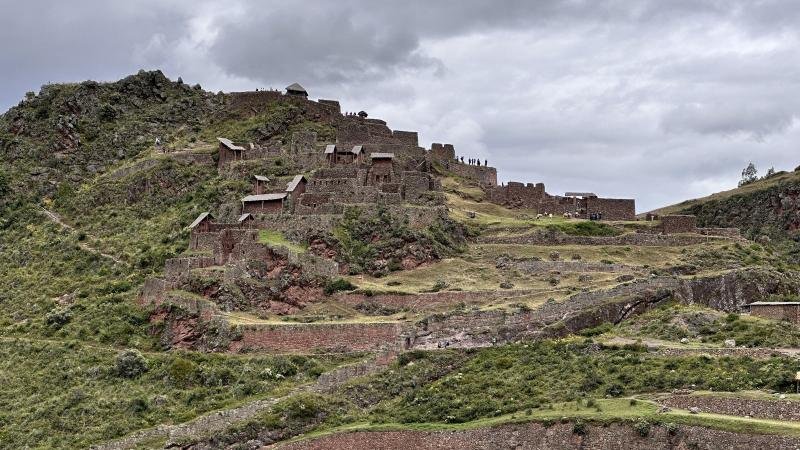
The archaeological park (Parque Arqueológico de Ollantaytambo) climbs the hill on the west side of the plaza in a stack of wide terraces, about 200 steps from the bottom to the top. Give it 90 minutes with a guide. The entry is the Boleto Turístico del Cusco, Circuit III (S/70 for foreign adults, valid two days, as of August 2026 per COSITUC), the same ticket that opens Pisac, Chinchero and Moray.
What you see on the climb
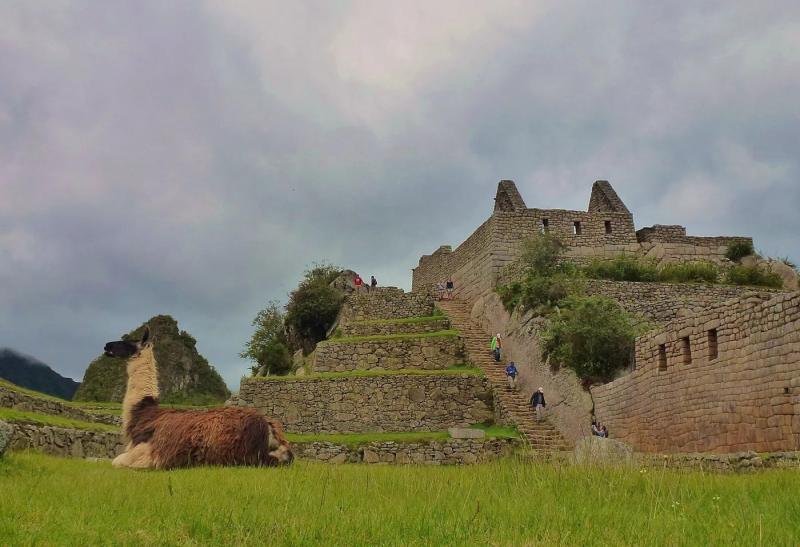
At the top stands the Temple of the Sun, and its main wall is six pink monoliths, each taller than a person, fitted with thin stone fillets between them. The stone came from the Kachiqhata quarry about 5.5 mi (9 km) away, on the far side of the river and far up the opposite slope. The Incas dragged the blocks down one mountain, across the river and up this one. Several blocks still lie abandoned along the route, and the people of the valley call them the tired stones. The temple was never finished. The Spanish arrived first.
On the way up and down look for the Ten Niches wall, the fountains at the foot of the hill where water still runs through Inca channels, and the view across the valley to Pinkuylluna, the hill with the storehouses. Go early or after 3 p.m. The tour buses stack up between 10 a.m. and 2 p.m., and the terraces have no shade.
Pinkuylluna: the free climb across the valley
On the hill east of the plaza, a path climbs to the stone storehouses of Pinkuylluna, where the Incas kept grain in the wind and cold above the valley. The climb takes about 20 minutes, it is steep and loose in places, and it costs nothing. The view back across the town to the fortress is, in our opinion, the best photograph in Ollantaytambo. Most tours skip it for lack of time, which is one argument for staying the night.
The town grid
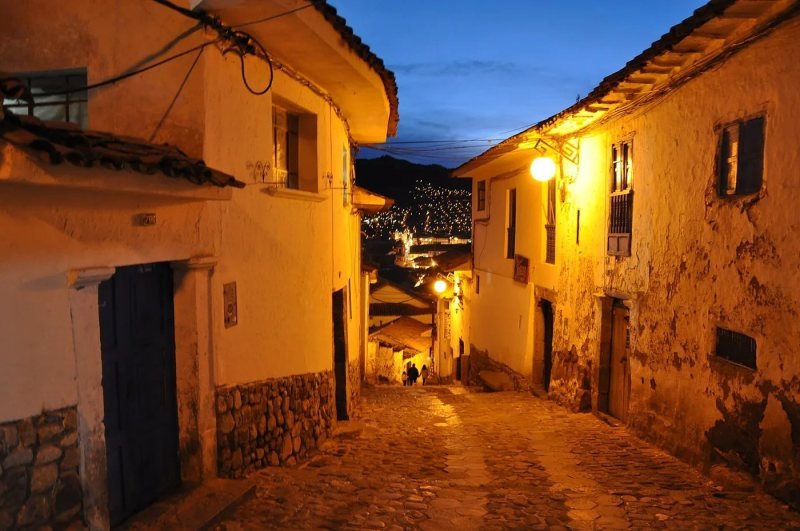
Walk two blocks north of the plaza and you are inside the Inca town. The layout is a grid of four long streets crossed by seven short ones, and the blocks are canchas, walled compounds of four one-room buildings around a shared courtyard. Families still live in them. Water runs down channels cut into the stone beside the lanes, and the doors are the trapezoid shape the Incas used everywhere. Some compounds let you look in for a small tip, and a few have become small hotels.
The part people get wrong is to treat the grid as ruins. It is a neighborhood. Keep to the lanes, ask before photographing a doorway with people in it, and buy your bread and bottled water in the town rather than at the station, where everything costs more.
The train station
The station is at the bottom of Avenida Ferrocarril, 10 to 15 minutes on foot from the plaza downhill along the river, or a few minutes by mototaxi. Both PeruRail and Inca Rail run from here to Aguas Calientes in 1.5 to 2 hours, and it is the busiest Machu Picchu station by far. Trains from Cusco itself take 3.5 to 4 hours and run less often, which is why nearly every tour, including every one of ours, drives you to Ollantaytambo and boards here. Our Machu Picchu train guide compares the classes and the timetable.
How a train day works
Arrive at the station 30 minutes before departure with your passport and the printed or digital ticket. Staff check names against passports. The luggage rule matters: PeruRail allows one backpack up to 8 kg (17.6 lb) or one carry-on up to 12 kg (26.5 lb), so your big suitcase stays in Cusco or at your valley hotel. Sit on the left going down for the river. The train follows the Urubamba into a canyon that gets greener and warmer every mile, and Aguas Calientes is humid and mild when you step off. Our guide on how to get to Machu Picchu lays out the whole chain from Cusco to the citadel gate.
If you want the citadel in one day without a hotel night, our day trip by train from Ollantaytambo picks you up in Cusco around 4 a.m., boards the early train here and gets you back to Cusco late the same night, from US$317 with the ticket, the train and the bus included.
Is Ollantaytambo worth a night?
Yes, and we would choose it over a second night in Cusco for most travelers heading to Machu Picchu. The reasons are practical. The town is 2,000 ft (600 m) lower than Cusco, so you sleep better. The station is a 15-minute walk, so a 6 a.m. train means a 5:15 alarm instead of a 3:30 pickup. And the fortress and Pinkuylluna at 7 a.m., before the buses, are a different place from the fortress at noon.
The trade-off is the town itself. It is small, the restaurants close early, nightlife does not exist, and the plaza fills with tour groups through the middle of the day. Hotels range from family compounds inside the Inca grid to lodges along the river, and our Sacred Valley hotel guide compares them by walking time to the station. If you come on a Sacred Valley day tour and go back to Cusco, you will see the fortress and not much else. Our Sacred Valley guide lays out the valley stop by stop so you can decide where the night fits.
One more use for the night: altitude. If you land in Cusco and feel rough, a van to Ollantaytambo the same afternoon puts you at 9,160 ft (2,792 m) for the first night instead of 11,150 ft (3,400 m). Our Cusco altitude guide explains why sleeping lower on the first night helps.
| Fact | Value | Source |
|---|---|---|
| Altitude | 9,160 ft (2,792 m) | en.wikipedia.org |
| Distance from Cusco | about 37 mi (60 km) by road, 1 hour 45 minutes to 2 hours | |
| Fortress entry | Boleto Turístico del Cusco, Circuit III, S/70 foreign adults, valid 2 days (as of August 2026) | cosituccusco.pe |
| Pinkuylluna storehouses | free, about 20 minutes uphill from the plaza | |
| Station to plaza | 10 to 15 minutes on foot along Avenida Ferrocarril | |
| Train to Aguas Calientes | 1.5 to 2 hours (PeruRail and Inca Rail). From Cusco or Poroy 3.5 to 4 hours | perurail.com |
| Train luggage | one backpack up to 8 kg (17.6 lb) or one carry-on up to 12 kg (26.5 lb) on PeruRail | perurail.com |
| Built | rebuilt by Pachacuti in the mid 1400s on an older town. Site of Manco Inca's victory over the Spanish in 1537 | en.wikipedia.org |
Sources
- Ollantaytambo, Wikipedia (altitude, Pachacuti, 1537 battle, grid of four by seven streets, canchas, Temple of the Sun, Pinkuylluna)
- Kachi Qhata, Wikipedia (quarry about 9 km from the town)
- COSITUC, Boleto Turístico del Cusco, tarifario (Circuit III price, updated August 1, 2026)
- PeruRail, train services (travel times from Ollantaytambo and Cusco)
- PeruRail, luggage policy
Questions people ask
Is Ollantaytambo worth a night?
Yes, for anyone taking the train to Machu Picchu. It sits 2,000 ft (600 m) below Cusco, the station is a 15-minute walk, and you get the fortress and the Pinkuylluna storehouses before the tour buses arrive. The trade-off is a quiet town with early-closing restaurants. If you want nightlife, stay in Cusco and leave early.
How far is the Ollantaytambo station from the plaza?
About 10 to 15 minutes on foot, downhill from the plaza along Avenida Ferrocarril to the river. Mototaxis wait on the plaza and take a few minutes. Give yourself 30 minutes before departure at the station, since staff check every passport against the ticket before boarding.
How do you get from Cusco to Ollantaytambo?
By road, in just under two hours. Tour vans go through Chinchero over the plateau or through Pisac and Urubamba along the valley. Shared vans leave Cusco through the day, and a taxi is the other option. There is no train from Cusco to Ollantaytambo for ordinary passengers in the way there is from Ollantaytambo to Machu Picchu, so plan on the road.
What is the entrance fee for the Ollantaytambo ruins?
The fortress opens with the Boleto Turístico del Cusco. The Circuit III partial ticket costs S/70 for foreign adults and is valid two days for Pisac, Ollantaytambo, Chinchero and Moray, and the full ticket costs S/130 for 10 days (as of August 2026, per COSITUC). Our Sacred Valley tours include it. Pinkuylluna, across the valley, is free.
How long do you need in Ollantaytambo?
Two hours covers the fortress with a guide and a short walk through the Inca grid. Half a day adds Pinkuylluna, the market and lunch. A night adds the early light on the terraces and a calm walk to the train. Tours give you the first option. If the town speaks to you, it is the second and third that pay off.
Is Ollantaytambo lower than Cusco?
Yes. Ollantaytambo sits at 9,160 ft (2,792 m) and Cusco at 11,150 ft (3,400 m), a difference of about 2,000 ft (600 m). People who struggle in Cusco often feel better here, which is one reason to spend the first night in the valley if you can arrange the transfer.
This guide was last reviewed in October 2026. Prices, rules and timetables are quoted with the date we checked them.