


Machu Picchu History and Facts, Sourced
Machu Picchu is an Inca royal estate built for the emperor Pachacuti in the 1400s on a ridge at 7,970 ft (2,430 m). Radiocarbon dates put its use between about AD 1420 and 1530. It was left around the Spanish conquest, never found by the Spanish, shown to the world by Hiram Bingham in 1911 and listed by UNESCO in 1983.

In this guide
Short answer: Machu Picchu is an Inca royal estate built for the emperor Pachacuti in the 1400s, on a ridge at 7,970 ft (2,430 m) above the Urubamba River. Radiocarbon dates on remains from the site put its use between about AD 1420 and 1530. It was left around the time of the Spanish conquest, never found by the Spanish, shown to the world by Hiram Bingham in 1911 and listed by UNESCO in 1983.
Guides say a lot of things on the terraces, and some of them are invented. This page keeps to what the sources support: the archaeology published in journals, the Peruvian ministry's own pages and the record of the 1911 expedition. Where the experts disagree, the text says so. For how the site is visited, with the circuits and the tickets, our guide to the Machu Picchu circuits takes over where this one stops.
Timeline of Machu Picchu
The site has two histories: about a century of Inca use, then four centuries of silence broken by farmers, a map and an American expedition. The table lists the dated events with their sources. Three dates carry the story: the 1420s, when the radiocarbon record starts, 1911, when Bingham climbed the ridge, and 1983, when UNESCO listed the sanctuary.
| Date | Event | Source |
|---|---|---|
| About 1420 | Earliest radiocarbon dates on people buried at the site | Burger et al., Antiquity, 2021, via Yale News |
| 1438 | Pachacuti takes power, per the Spanish chronicles | Yale News summary of the 2021 study |
| About 1450 | Traditional date for the start of construction as Pachacuti's estate | Wikipedia, citing Rowe and later archaeology |
| About 1530 | Use of the site ends around the Spanish conquest | Burger et al., 2021 |
| 1588 | A colonial record names the place Huayna Picchu | Amado and Bauer, Ñawpa Pacha, via Sci.News and NPR |
| 1874 | Herman Göhring's map marks Machu Picchu and Huayna Picchu | Wikipedia |
| 1902 | Agustín Lizárraga visits and leaves an inscription | Wikipedia (Hiram Bingham III) |
| 24 July 1911 | Hiram Bingham reaches the site with Melchor Arteaga | Wikipedia, Yale News |
| 1912, 1914, 1915 | Yale expeditions clear and excavate the site | Wikipedia (Hiram Bingham III) |
| 1948 | Lost City of the Incas published, road up named Carretera Hiram Bingham | Wikipedia (Hiram Bingham III) |
| 1981 | Peru declares the Historic Sanctuary, 32,592 ha | Wikipedia |
| 1983 | UNESCO World Heritage inscription, criteria i, iii, vii, ix | whc.unesco.org list no. 274, via Wikipedia (UNESCO page blocked to our reader) |
| 2007 | Named one of the New Seven Wonders by a Swiss foundation's poll | Wikipedia |
| 2011 to 2012 | Yale returns the objects to Peru, Casa Concha opens in Cusco | Yale News |
| 2021 | Radiocarbon study dates use to about 1420 to 1530 | Yale News |
| 1 June 2024 | 3 circuits and 10 routes come into force | machupicchu.gob.pe |
Who built Machu Picchu and when
Machu Picchu was built by the Inca state as a royal estate for Pachacuti Inca Yupanqui, the ruler whose conquests turned Cusco into an empire. The estate theory comes from the archaeologist John Rowe, who read colonial land documents naming the area as the property of Pachacuti's lineage, and it is the explanation the archaeological record supports. The Spanish chronicles date Pachacuti's rise to 1438 and the start of the site to about 1450.
Radiocarbon dating moved that date earlier. A study led by Richard Burger of Yale, published in the journal Antiquity in 2021, dated the remains of 26 people buried at the site and excavated in 1912. The results show Machu Picchu in use from about AD 1420 to AD 1530, at least 20 years before the chronicles suggest. The gap matters to historians because it means Pachacuti's expansion started before the Spanish-era accounts say it did.
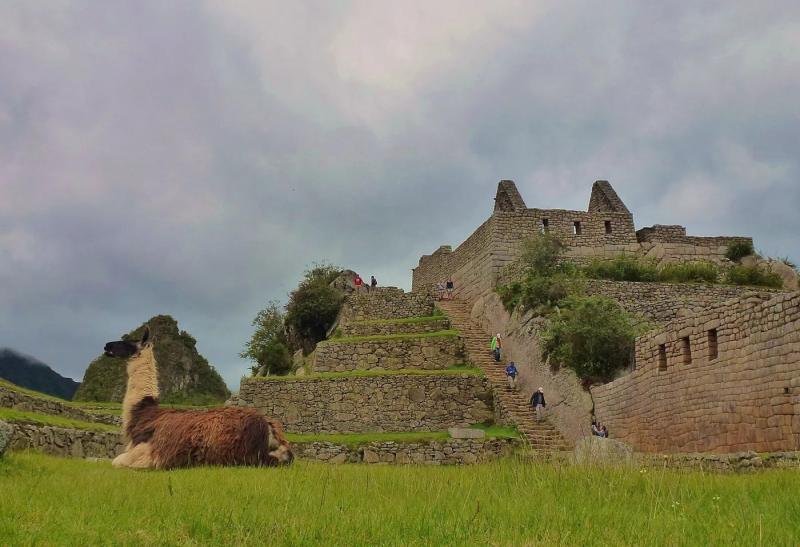
The Inca built without mortar. The temples and the royal sector are fitted ashlar, each granite block shaped to lock against the next, while the housing and the storerooms use rougher fieldstone set in clay. Around 200 structures stand on the ridge, split into an agricultural sector of terraces and an urban sector of plazas, temples, houses and fountains fed by a spring. About 750 people lived here at a time, most of them staff who kept the estate running for the emperor's visits, per the summary of the excavation record.
Why it was left
Nobody wrote down why Machu Picchu was abandoned, and the honest answer is that the record ends with the Inca state. Use of the site stops around 1530, the decade the Spanish reached Peru, the empire's civil war ended and epidemics moved through the Andes. A royal estate with no royal court had no purpose, and its staff went back to their villages.
What the sources do say is that the Spanish never reached the ridge. The site appears in colonial land papers as a place with a name and an owner, not as a ruin anyone visited, which is why the buildings were never torn down for a church or a hacienda. By the 1800s the terraces were being farmed by local families, and a map drawn in 1874 by the engineer Herman Göhring already marks the names Machu Picchu and Huayna Picchu on the two peaks.
The name
In Quechua, machu means old and pikchu means peak, so the name reads as old peak, and Huayna Picchu, the sharp mountain behind the classic view, is young peak. Both are names of mountains, not of the city. A study published in 2021 in the journal Ñawpa Pacha by the Peruvian historian Donato Amado Gonzales and the archaeologist Brian Bauer of the University of Illinois Chicago went through Bingham's field notes, early maps and 16th and 17th century documents in the Cusco regional archive and found that the Inca city itself was most likely called Huayna Picchu, or simply Picchu. A 1588 record mentions local people wanting to return to the site they called Huayna Picchu, and Bingham was first told that name in 1911 before another guide gave him the one that stuck.
The name is not going to change on the tickets, and the official site uses Llaqta de Machupicchu, llaqta being the Quechua word for a town. Knowing the mix-up helps on the circuits: the mountain called Huayna Picchu on your ticket is the peak, and the city you walk through probably once carried the same name.
1911 and after
Hiram Bingham, a Yale lecturer in South American history, reached Machu Picchu on 24 July 1911 while leading the Yale Peruvian Expedition in search of the last Inca capital, Vilcabamba. A local farmer, Melchor Arteaga, led him up the ridge from the river. Bingham found families farming the terraces and, on a wall, a charcoal inscription left by Agustín Lizárraga, a local landowner who had visited in 1902. Bingham noted it in his journal and later played it down, which is why the word discovery sits badly with Peruvian historians: the site was known locally, and Bingham's achievement was to recognize what it was and to tell the world.
He came back in 1912 to clear and excavate, with support from Yale and the National Geographic Society, and again in 1914 and 1915. The expeditions shipped thousands of objects to Yale, pottery, metalwork and the human remains that Burger's team later dated. Bingham wrote Inca Land in 1922 and Lost City of the Incas in 1948, the book that fixed the site in the American imagination and the year the road up from Aguas Calientes, the Carretera Hiram Bingham, opened and was named for him. He went on to serve as a US senator for Connecticut from 1925 to 1933.
The objects came home a century later. Yale and Peru signed an agreement in November 2010, the first pieces went on show in Lima in March 2011 and then at the Casa Concha in Cusco, where the UNSAAC-Yale center for the study of Machu Picchu opened that October, and the rest of the collection returned in December 2011 and December 2012, per Yale. The Casa Concha, two blocks from the Plaza de Armas, is the place to see the finds before or after your visit.
Protection: 1981, 1983 and the daily limit
Peru declared the Historic Sanctuary of Machu Picchu (Santuario Histórico de Machupicchu) in 1981, a protected area of 80,535 acres (32,592 ha) that covers the ridge, the cloud forest around it and the Inca Trail routes, managed by SERNANP for the natural side and by the Ministerio de Cultura for the archaeology. In 1983 UNESCO inscribed the sanctuary on the World Heritage List as a mixed cultural and natural site, under criteria i, iii, vii and ix. In 2007 the site was voted one of the New Seven Wonders of the World, a poll run by a Swiss foundation with no UNESCO standing, which still pushed visitor numbers up over the following decade.
| Fact | Value | Source |
|---|---|---|
| Altitude | 2,430 m (7,970 ft) | tuboleto.cultura.pe |
| Built for | Pachacuti Inca Yupanqui, as a royal estate | Rowe's estate theory, via Wikipedia and Yale News |
| Period of use | About AD 1420 to 1530 | Burger et al., Antiquity, 2021 |
| Structures | About 200 | Wikipedia |
| Population | About 750 at a time, mostly staff | Wikipedia, citing the excavation record |
| Meaning of the name | Machu = old, pikchu = peak, in Quechua | Wikipedia |
| Likely Inca name of the city | Huayna Picchu or Picchu | Amado and Bauer, Ñawpa Pacha |
| Protected area | 32,592 ha (80,535 acres), Historic Sanctuary since 1981 | Wikipedia |
| UNESCO | World Heritage since 1983, mixed site, criteria i, iii, vii, ix | whc.unesco.org no. 274, via Wikipedia |
| Daily limit | 5,600 high season, 4,500 the rest (2026 calendar) | RM 000285-2025-MC via Andina |
| Visitors a year | Over 1.5 million (2025 figure) | Wikipedia, to confirm with the Ministerio de Cultura |
Protection today is a number. The Ministerio de Cultura caps entries at 5,600 a day on high-season dates and 4,500 on the rest (as of the 2026 calendar, Ministerial Resolution 000285-2025-MC), and since 1 June 2024 every ticket is tied to one of 3 circuits and 10 one-way routes with a maximum time inside. The caps are the reason tickets sell out and the reason the ridge still has grass on it. How to buy one is in our Machu Picchu tickets guide.
Seeing it for yourself
The history lands differently once you stand in the Plaza of the Temples with the Temple of the Three Windows at your back. The Machu Picchu destination page shows every package that includes the citadel, and our Machu Picchu tours from Cusco put a licensed guide beside you inside Circuit 2, which is the route that passes the Temple of the Sun, the Intihuatana stone and the Temple of the Condor. Ask the guide about the name. The good ones will tell you the Amado and Bauer paper without prompting.
Questions people ask
Who built Machu Picchu?
The Inca state, for the emperor Pachacuti Inca Yupanqui as his royal estate, the ruler credited with turning Cusco into an empire. The estate theory rests on colonial land documents read by the archaeologist John Rowe and on the excavated record, which shows a settlement of about 750 people, most of them staff. No single architect is known, and the labor came from the Inca system of rotating work service.
When was Machu Picchu built?
In the early 1400s. The Spanish chronicles put Pachacuti's rise at 1438 and the site at about 1450, but a radiocarbon study from Yale published in Antiquity in 2021 dated 26 people buried at the site and found it in use from about AD 1420 to 1530. The construction likely began in the 1420s and continued through the century.
Why was Machu Picchu abandoned?
No source records a reason. Occupation ends around 1530, the decade of the Spanish arrival, the Inca civil war and the first epidemics. A royal estate without a court had no purpose, so the staff left. The conquerors never climbed the ridge, which is why the walls were never pulled down and the site was known only to local families until 1911.
Who discovered Machu Picchu?
Local families farmed its terraces long before anyone discovered it. Agustín Lizárraga, a landowner from the valley, left a dated inscription in 1902. Hiram Bingham of Yale reached the site on 24 July 1911, led by the farmer Melchor Arteaga, recognized what it was and published it, which is why his name is attached to it. Peruvian historians prefer the phrase scientific discovery for his role.
What does Machu Picchu mean?
Old peak, in Quechua: machu is old and pikchu is a peak or summit. Huayna Picchu, the steep mountain behind the classic view, means young peak. A 2021 study by Donato Amado Gonzales and Brian Bauer concluded that the Inca city was most likely called Huayna Picchu, or Picchu, and that the name Machu Picchu was attached to the ruins only from 1911.
Is Machu Picchu one of the Seven Wonders of the World?
In 2007 a worldwide poll run by a Swiss foundation named it one of the New Seven Wonders of the World, a label with no UNESCO standing. Its official status is older and carries more weight: Peru declared the Historic Sanctuary in 1981, and UNESCO inscribed it on the World Heritage List in 1983 as a mixed cultural and natural site.
How many people visit Machu Picchu?
Over 1.5 million a year, per the figure reported for 2025, within a daily cap set by the Ministerio de Cultura of 5,600 visitors on high-season days and 4,500 otherwise (as of the 2026 calendar, Ministerial Resolution 000285-2025-MC). Every ticket is tied to one of 10 one-way routes with a time limit inside, which is how the cap is enforced.
Sources
- Yale News, Machu Picchu older than expected, study reveals (Burger et al., Antiquity, 2021) checked October 2026
- Sci.News, Huayna Picchu is the original name of the Inca city (Amado and Bauer, Ñawpa Pacha) checked October 2026
- NPR via WRVO, Historians say explorers got it wrong: it's Huayna Picchu checked October 2026
- Yale News, Peru-Yale partnership for the Machu Picchu artifacts (return 2011 to 2012) checked October 2026
- Yale News, UNSAAC-Yale center opens in Cusco (October 2011) checked October 2026
- Wikipedia, Machu Picchu (altitude, estate theory, population, sanctuary 1981, UNESCO 1983 and criteria, New Seven Wonders, Göhring map) checked October 2026
- Wikipedia, Hiram Bingham III (1911, Lizárraga 1902, expeditions, books, Senate) checked October 2026
- UNESCO World Heritage List, Historic Sanctuary of Machu Picchu (no. 274) checked October 2026
- tuboleto.cultura.pe, Llaqta de Machupicchu checked October 2026
- Ministerio de Cultura, circuits and routes checked October 2026
- Andina, Machu Picchu 2026 ticket rates and visitor limits (RM 000285-2025-MC) checked October 2026
This guide was last reviewed in October 2026. Prices, rules and timetables are quoted with the date we checked them.