




Puno Altitude and Weather, Month by Month at Lake Titicaca
Puno sits at about 12,570 ft (3,830 m), roughly 1,400 ft higher than Cusco, on Lake Titicaca. Daytime highs stay between 59 and 64°F (15 and 18°C) all year. Nights drop to around freezing from June to August, and most rain falls from December to March.

In this guide
You step off the bus in Puno in the late afternoon and the light is sharp, almost white, and the air smells of dust and eucalyptus smoke. By the time you have carried your bag up two flights of hotel stairs you are breathing like you ran them. At 7 p.m. the sun drops behind the hills and the temperature falls with it, fast, the way it does in a desert. That is Puno: bright, dry, high and cold at night, every month of the year.
Short answer: Puno sits at about 12,570 ft (3,830 m), roughly 1,400 ft (430 m) higher than Cusco, on the shore of Lake Titicaca at 12,507 ft (3,812 m). Days reach 59 to 64°F (15 to 18°C) all year. Nights fall to around freezing from June to August. Rain falls mostly from December to March.
The numbers on this page come from Peru's national weather service, SENAMHI, and from the US CDC for altitude. The advice comes from putting travelers on the boats in Puno every month of the year.
How high is Puno?
Puno's city center is at about 12,570 ft (3,830 m) above sea level, and the weather station that SENAMHI uses for the city sits at 12,549 ft (3,825 m). The town climbs from the lakeshore at 12,507 ft (3,812 m) up the surrounding hills, so the higher neighborhoods and the Kuntur Wasi viewpoint above the center are higher still. For planning, use 12,570 ft (3,830 m), the figure we use across this site.
What matters is the comparison. Puno is higher than Cusco at 11,152 ft (3,399 m), higher than La Paz at about 11,975 ft (3,650 m), and about the same height as Juliaca, the airport town an hour north. If you have spent a week in Cusco, the step up is small. If you fly in from Lima, it is the biggest climb of your trip. Our Lake Titicaca altitude guide has the full table for the islands and the road from Cusco.
| Item | Figure | Source |
|---|---|---|
| Puno city center | about 12,570 ft (3,830 m) | Wikipedia, Puno infobox |
| Puno weather station | 12,549 ft (3,825 m) | SENAMHI normals 1991 to 2020, via Wikipedia |
| Lake Titicaca surface | 12,507 ft (3,812 m) | Wikipedia, Lake Titicaca infobox |
| Cusco, for comparison | 11,152 ft (3,399 m) | Wikipedia, Cusco infobox |
| Juliaca, the airport town | 12,549 ft (3,825 m) | Wikipedia, Juliaca infobox |
| Average high, all year | 59 to 64°F (14.8 to 17.7°C) | SENAMHI normals 1991 to 2020 |
| Average low, June and July | 31°F (minus 0.5 and minus 0.8°C) | SENAMHI normals 1991 to 2020 |
| Rain per year | 27.1 in (689 mm), 74% of it December to March | SENAMHI normals 1991 to 2020 |
| Lake water temperature | 50 to 57°F (10 to 14°C) | Wikipedia, Lake Titicaca |
Puno weather by month
Puno has two seasons: a dry season from May to September with clear skies and frosty nights, and a rainy season from December to March with milder nights and afternoon storms. Daytime highs barely change through the year, between 59 and 64°F (15 and 18°C). The night is what changes, and so does the rain: about 6 inches (159 mm) in January against a tenth of an inch (3 mm) in June.
The table gives SENAMHI's monthly averages for 1991 to 2020. Read the low column first, because the cold at night is what catches people out.
| Month | Average high | Average low | Rain | What to expect |
|---|---|---|---|---|
| January | 61°F (16°C) | 43°F (5.9°C) | 6.2 in (158.7 mm) | Rainy season, afternoon storms, mild nights |
| February | 60°F (15.7°C) | 43°F (5.9°C) | 5.7 in (144.9 mm) | Rainy, Candelaria festival in early February |
| March | 60°F (15.6°C) | 42°F (5.5°C) | 4.6 in (116.3 mm) | Rain easing, green hills |
| April | 60°F (15.7°C) | 39°F (4°C) | 2.0 in (50.8 mm) | Last showers, cooler nights |
| May | 60°F (15.5°C) | 34°F (1.2°C) | 0.28 in (7.2 mm) | Dry and clear, nights near freezing |
| June | 59°F (14.8°C) | 31°F (-0.5°C) | 0.12 in (3 mm) | Coldest nights, clearest skies |
| July | 59°F (14.9°C) | 31°F (-0.8°C) | 0.13 in (3.4 mm) | Coldest month, busiest travel season |
| August | 60°F (15.7°C) | 33°F (0.4°C) | 0.38 in (9.6 mm) | Dry, cold nights, windy afternoons |
| September | 62°F (16.6°C) | 36°F (2.3°C) | 0.93 in (23.5 mm) | Dry, nights getting milder |
| October | 63°F (17.2°C) | 39°F (3.8°C) | 1.7 in (44.1 mm) | Warm afternoons, first storms |
| November | 64°F (17.7°C) | 40°F (4.7°C) | 1.6 in (40 mm) | Warmest afternoons of the year |
| December | 63°F (17.2°C) | 42°F (5.6°C) | 3.4 in (87.6 mm) | Rainy season begins in earnest |
| Year | 61°F (16.0°C) | 38°F (3.2°C) | 27.1 in (689.1 mm) | Dry May to September, wet December to March |
Dry season, May to September
From May to September the sky over Puno is a deep, cloudless blue most days, and the lake is calm in the morning. June and July are the coldest months, with average lows just under freezing at 31°F (minus 0.5 to minus 0.8°C), and a frosty windshield on the parked minivans is a normal sight at 6 a.m. By 10 a.m. you are in shirtsleeves in the sun, and by 6 p.m. you want a down jacket. Expect a temperature swing of about 27°F (15°C) in a single day.
We recommend these months for a first visit. The boats run on flat water, the views to the Bolivian mountains are clear, and almost no rain falls: less than half an inch (10 mm) a month from May to August.
Rainy season, December to March
From December to March most of the year's rain arrives, about 20 inches (507 mm) in four months, usually as heavy afternoon showers that roll across the lake from the east. Mornings are often clear, so boat days start on time and the rain catches you, if it catches you, on the way back. Nights are milder, around 41 to 43°F (5 to 6°C), and the hills around the city turn green.
Travel in these months is fine if you pack a real rain jacket and plan the islands for the morning. Early February is the Fiesta de la Virgen de la Candelaria, when the city fills with dancers and hotels fill months ahead. Our things to do in Puno guide covers the festival.
April, October and November
April, October and November sit between the seasons, and they are our favorite months in Puno after the dry winter. April has green hills and the last showers. October and November have the warmest afternoons of the year, 63 to 64°F (17 to 18°C), nights a few degrees above freezing and only scattered storms, about 1.5 to 1.7 inches (40 to 44 mm) a month.
Lake Titicaca weather on the water
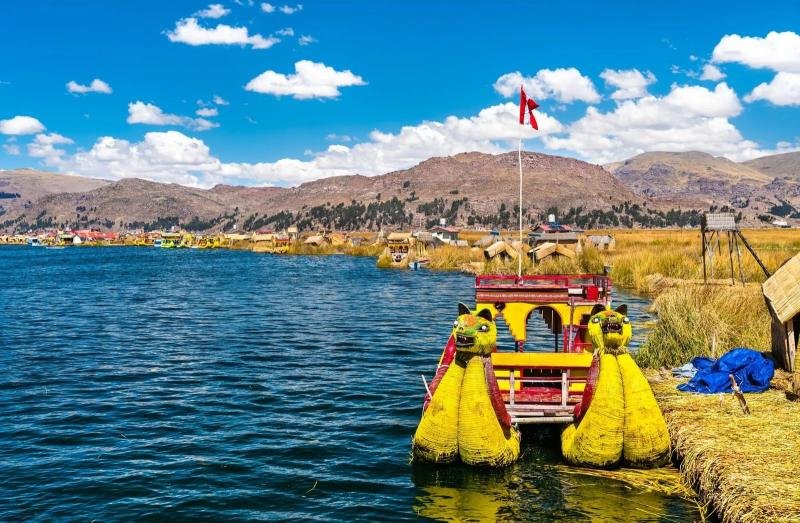
Lake Titicaca weather on a boat is colder and brighter than Puno weather on land. The water stays between 50 and 57°F (10 and 14°C) all year, so the air over it stays cool, and a breeze off the lake makes 60°F feel like 50. On the open stretch to Taquile and Amantaní the wind picks up after midday. The people who suffer on the boat are the ones in a cotton T-shirt on the roof deck at noon.
The sun is the other half of it. At 12,500 ft the air filters less ultraviolet light, and the reflection off the water doubles the dose. We see sunburned noses and ears on every boat that comes back from Taquile in July, a month when the air never gets warm. Wear a hat with a brim, sunglasses and sunscreen even when you feel cold. The Uros floating islands guide and the Taquile and Amantaní guide explain the boat day itself.
Cold nights in Puno
The nights are the hard part of Puno weather. In the dry months the temperature drops below freezing after midnight, and many houses and smaller hotels in the city have no central heating, because the days are mild. Inside an unheated room in July you sleep at around 45°F unless the hotel gives you heaters, extra blankets or both.
Ask two questions when you book a hotel: does the room have heating, and is there hot water at night. On Amantaní the family homestays have no heating at all, and you sleep under a pile of alpaca and wool blankets. It is cozy once you are in, and very cold getting out. Our guide to the hotels in Puno and on Lake Titicaca notes which ones have heating.
Altitude sickness in Puno
Altitude sickness is a real risk in Puno for anyone arriving from low ground, because the US CDC places the risk for unacclimatized travelers at sleeping altitudes of 8,000 ft (2,450 m) or more, and Puno is 4,500 ft above that. The CDC lists headache as the main symptom, usually with tiredness, dizziness, loss of appetite or nausea, starting 2 to 12 hours after you arrive. Mild cases usually clear in 12 to 48 hours if you do not go higher.
The CDC's rules for the first two days are simple. Keep to mild activity for the first 48 hours, avoid alcohol for the first 48 hours, and above 9,800 ft (3,000 m) do not raise your sleeping altitude by more than about 1,600 ft (500 m) a night. Cusco to Puno is about 1,400 ft (430 m), inside that rule, which is why Puno belongs after Cusco in a Peru trip.
Know the warning signs. Confusion, clumsiness or unusual drowsiness, or breathlessness at rest with a wet cough, are not ordinary altitude sickness. The CDC describes them as signs of brain or lung swelling, and the answer is to get medical help and go lower. If you have heart or lung disease, sleep apnea or sickle cell trait, the CDC advises seeing a doctor who knows high-altitude medicine before the trip. Ask your own doctor about altitude medication. This page gives facts, not medical advice, and our Cusco altitude guide covers prevention in more detail.
If you fly straight into Juliaca
Flying from Lima to Juliaca takes you from sea level to 12,549 ft (3,825 m) in about an hour and a half. Treat the first day as a rest day: the transfer to Puno, a light lunch, a slow walk, no pisco and an early night. Book the Uros and Taquile boat for day two, never for the afternoon you land.
What to wear in Puno
Dress in layers you can add and remove through the day, because Puno weather runs from frost at dawn to strong sun at noon. Here is what we tell our own travelers to pack for any month:
- A thermal base layer (top and bottom) for nights and early starts.
- A fleece or wool sweater.
- A warm jacket: a down or synthetic puffer for May to September.
- A windproof and waterproof shell, essential from December to March.
- A warm hat, light gloves and a scarf or buff for the boat.
- A sun hat with a brim, sunglasses and SPF 50 sunscreen.
- Comfortable walking shoes with grip for the stone paths on Taquile.
- Lip balm and moisturizer, because the air is very dry.
The mistake we see most is packing for "summer in Peru" in December and arriving at a lake where the night is 41°F (5°C) and it rains every afternoon. The other one is the reverse: a heavy coat and nothing light for a 63°F October afternoon in the sun. For the full list, see the Peru packing list.
Plan your Puno days around the weather
Plan two nights in Puno and use the weather to order them. Arrive in the afternoon, walk slowly and eat early. Take the boat day on day two, leaving in the morning when the lake is calmest. In the rainy months, keep the land visits, the city or Sillustani, for the morning too.
Our Uros and Taquile full day from Puno, US$127 per person, is the boat day we use, with lunch cooked by families on Taquile. Travelers coming from Cusco usually reach the lake on our 10-day trip from Lima to Lake Titicaca with a lake ceremony, from US$1,347, which puts Puno at the end of the trip, after a week of acclimatizing in Cusco. Every trip that touches the lake is on our Lake Titicaca tours page.
Sources
- Puno, Wikipedia: elevation 3,830 m and the climate table for Puno station, 3,825 m, sourced to SENAMHI, Normales Climáticas Estándares y Medias 1991 to 2020
- SENAMHI, Servicio Nacional de Meteorología e Hidrología del Perú
- CDC Yellow Book, High Altitude Travel and Altitude Illness
- Lake Titicaca, Wikipedia: surface elevation 3,812 m and water temperature
- Juliaca, Wikipedia: elevation 3,825 m
Related tours


Questions people ask
Is Puno higher than Cusco?
Yes. Puno sits at about 12,570 ft (3,830 m) and Cusco at 11,152 ft (3,399 m), so Puno is roughly 1,400 ft (430 m) higher. That is why most Peru trips do Cusco first and Lake Titicaca at the end: after a week in Cusco the climb to Puno is small, while flying from Lima to Juliaca is a jump of almost 12,550 ft in one flight.
What is the coldest month in Puno?
July, by a small margin over June. SENAMHI's 1991 to 2020 averages give Puno a July low of 31°F (minus 0.8°C) and a high of 59°F (14.9°C). Days are sunny and pleasant, nights freeze, and unheated rooms get cold. Pack a down jacket, a warm hat and thermal layers for June to August.
When is the rainy season in Puno?
December to March. Those four months bring about 74% of Puno's yearly rain, with January the wettest at about 6.2 inches (159 mm), according to SENAMHI's 1991 to 2020 averages. Rain usually comes as afternoon storms, so morning boat trips to the Uros and Taquile still run. May to August is almost completely dry.
Does Puno freeze at night?
Yes, from about June to August. Average lows in June and July are just under freezing, 31°F (minus 0.5 to minus 0.8°C), and frost is common at dawn. In May and August lows sit just above freezing. Ask your hotel whether rooms are heated, and on an Amantaní homestay expect no heating, only heavy blankets.
Will I get altitude sickness in Puno?
You might, if you arrive from low ground. The CDC places the risk at sleeping altitudes above 8,000 ft (2,450 m), and Puno is at 12,570 ft (3,830 m). Coming from a week in Cusco, most travelers feel only mild breathlessness. Flying straight in from Lima, plan a rest day, skip alcohol for 48 hours and ask your doctor about medication.
What should I wear in Puno?
Layers. A thermal base layer, a fleece, a warm puffer jacket for May to September, a windproof rain shell for December to March, a warm hat and gloves for the boat, plus a sun hat, sunglasses and SPF 50. Afternoons reach 59 to 64°F (15 to 18°C) in the sun, and nights are 30 to 40°F colder.
This guide was last reviewed in October 2026. Prices, rules and timetables are quoted with the date we checked them.