





Pisac, Peru: The Ruins, the Market and How to Visit
Pisac is a Sacred Valley town about 32 km (20 miles) from Cusco, at 2,972 m (9,751 ft), with an Inca site of more than 65 hectares on the ridge above it. The ruins sit at about 3,446 to 3,514 m, need the Boleto Turístico, and pair well with the town's market.

In this guide
At half past eight in the morning the terraces of Pisac are still in shadow on one side and bright green on the other. You stand on a stone ledge with your hands in your pockets, the wind coming up the gorge, and far below you the Urubamba River draws a silver line across the valley floor. The town is a grid of roofs down there. Somewhere in it, the market stalls are opening, and in two hours you will be bargaining for a blanket.
Short answer: Pisac is a Sacred Valley town about 32 km (20 miles) from Cusco, at 2,972 m (9,751 ft), with an Inca site of more than 65 hectares on the ridge above it. The ruins sit at about 3,446 to 3,514 m, need the Boleto Turístico, and pair well with the town's market, busiest on Tuesday, Thursday and Sunday.
Most visitors see Pisac in two hours on a Sacred Valley day tour. That is enough for the main sector and the market. With half a day, you can walk the ridge and come down to the town on foot. Here is how the site is laid out, what the ticket covers, and how to plan the visit.
Pisac at a glance
Pisac has two halves: a market town on the valley floor and an Inca site on the mountain above it, with about 500 m of height between them. Plan for both, and for the drive between them, which is about 15 minutes by road.
| Item | Detail |
|---|---|
| Location | Sacred Valley, Calca province, about 32 km (20 miles) from Cusco |
| Drive from Cusco | About 45 minutes |
| Town altitude | 2,972 m (9,751 ft) |
| Ruins altitude | About 3,446 to 3,514 m (11,306 to 11,529 ft) |
| Size of the site | More than 65.5 hectares |
| Built | Under Pachacuti, no earlier than about 1440 |
| Ticket | Boleto Turístico: S/130 full (10 days) or S/70 Circuit III (2 days), as of August 2026 |
| Market days | Daily, biggest on Tuesday, Thursday and Sunday |
| Time needed | 2 hours for the main sector, half a day to walk down to town |
The Pisac ruins
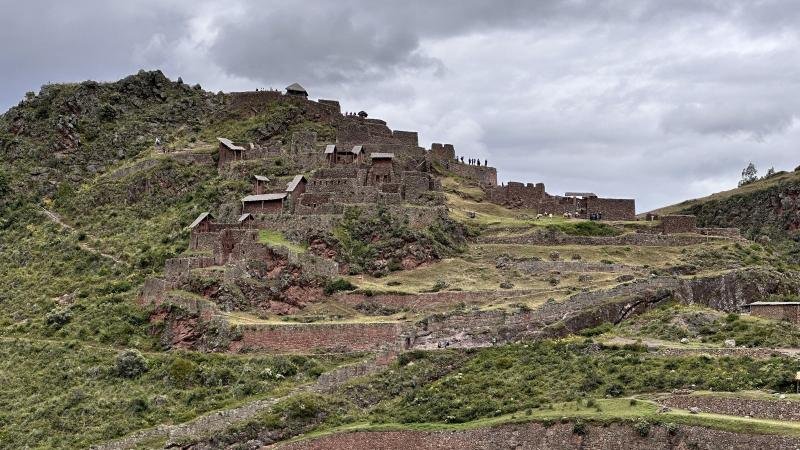
The Pisac archaeological park covers more than 65.5 hectares along a ridge above the town, and was built under the Inca ruler Pachacuti, no earlier than about 1440, according to Wikipedia's summary of the research. Archaeologists read it as a mix of residence, citadel, observatory and religious site. You walk between its sectors on narrow paths along the mountain, with long views down the valley on one side.
The terraces
The first thing you see from the road is the terraces: dozens of curved stone steps wrapped around the slope, still green and still holding soil after five centuries. They are the reason Pisac photographs so well. They also explain the place. The Incas turned a steep mountainside into farmland that could feed a large settlement.
Intiwatana, the ceremonial sector
Intiwatana is the religious heart of the site. Here the stonework changes. Instead of rough fieldstone you see fitted blocks of the finest Inca masonry, the same style as Qorikancha in Cusco, around a carved rock and a set of temples and fountains. Water still runs through some of the stone channels. Ask your guide to show you how the buildings line up with the sun.
Qallaq'asa and P'isaqa
Qallaq'asa is a residential sector on a spur of the ridge, built on a steep edge with views straight down to the valley. P'isaqa, another residential group, sits on the slope below. Both are quieter than Intiwatana, and both show how people lived in a place built on a cliff.
The tombs in the cliff
Look across the Kitamayo gorge behind the site and you will see hundreds of holes in the cliff wall. Lonely Planet describes them as Inca tombs, looted long ago by grave robbers. They are closed to visitors, and you see them only from the paths of the site.
Tickets: the Boleto Turístico
Pisac has no separate entrance ticket. You enter with the Boleto Turístico del Cusco, sold by COSITUC. The full ticket costs S/130 for foreign adults and is valid for 10 days at 16 sites, including Sacsayhuamán and the Sacred Valley. The partial Circuit III ticket costs S/70, is valid for 2 days and covers Pisac, Ollantaytambo, Chinchero and Moray (COSITUC price list, updated August 1, 2026).
Buy the full ticket if you will also visit the ruins around Cusco. Buy the Circuit III ticket if the Sacred Valley is your only day of sightseeing. Sacred Valley tours usually include the partial ticket, so check before you buy your own.
How to visit the ruins
Our guides visit Pisac from the top down, and we suggest you do the same. Drive up the paved road to the upper entrance, walk the ridge through Qallaq'asa and Intiwatana, and come back to the car or carry on down to the town. The ruins sit higher than Cusco, between about 3,446 and 3,514 m, so walk slowly if you arrived from Lima the day before.
Fit hikers can walk down to the town on the old Inca path, about 4 km of steep stone steps. Lonely Planet suggests taking a taxi up and walking back down, and notes that the trail has been closed at times, so ask at the entrance. Arrive early. The first tour buses from Cusco reach Pisac around 8:30 a.m., and by late morning the main paths are busy.
The Pisac market
Pisac's market fills the main square and the lanes around it every day, and is biggest on Tuesday, Thursday and Sunday, its official market days. On Sunday, people from the Quechua communities in the hills come down to sell produce, which gives the plaza a different feel from the souvenir stalls on weekdays.
Most stalls sell textiles, ceramics, silver and alpaca goods. Prices start high and bargaining is normal, so ask, smile, and offer less. Bring soles in small notes. The town's church of San Pedro Apóstol faces the square. It was rebuilt after the earthquake of 1950, according to Wikipedia.
Pisac and the altitude
The town of Pisac, at 2,972 m (9,751 ft), is about 430 m lower than Cusco, and many travelers sleep there or elsewhere in the valley on their first nights. The ruins are a different story. At up to 3,514 m they sit above the altitude of Cusco, and the paths include long stairs. Our guide to Sacred Valley altitude compares every town.
How to get to Pisac from Cusco
Pisac is about 45 minutes from Cusco by road, the first stop on most Sacred Valley tours. You can go by tour, by taxi or by the shared vans and buses that leave Cusco for the valley through the day. A tour solves the ride to the upper entrance of the ruins, which public transport does not reach.
Our Sacred Valley full-day tour starts at Pisac at about 8:30 a.m., goes to the market at 10:30, and continues to Urubamba, Ollantaytambo and Chinchero. It costs US$127 per person with the partial Boleto Turístico, a bilingual guide and a buffet lunch. If you are heading to Machu Picchu, the Sacred Valley and Machu Picchu 2-day tour starts at US$627 and ends the first day on the train from Ollantaytambo.
For the rest of the valley, read our Sacred Valley guide, stop by stop, the Ollantaytambo guide and the guide to Maras and Moray.
Related tours


Questions people ask
Is Pisac worth visiting?
Yes. Pisac combines a large Inca site, with terraces and fine temple stonework, and the main craft market of the Sacred Valley. It is the first stop on most Sacred Valley day tours, 45 minutes from Cusco, and two hours is enough for the main sector and a walk through the market.
How much does it cost to enter the Pisac ruins?
Pisac has no separate ticket. You enter with the Boleto Turístico del Cusco: S/130 for the full ticket, valid 10 days at 16 sites, or S/70 for the Circuit III ticket, valid 2 days at Pisac, Ollantaytambo, Chinchero and Moray (foreign adults, COSITUC price list of August 2026).
What days is the Pisac market?
The Pisac market opens every day, but its official market days, and the biggest, are Tuesday, Thursday and Sunday. On Sunday people from the Quechua communities in the hills come to sell produce. Weekday stalls are mostly textiles, ceramics, silver and alpaca goods.
Can you walk from Pisac town to the ruins?
Yes, on a steep Inca path of about 4 km with many stone steps, when it is open. Lonely Planet puts the climb at about two hours and suggests taking a taxi up and walking down instead. The trail has been closed at times, so ask in town before you set out.
How high are the Pisac ruins?
The Pisac ruins sit at about 3,446 to 3,514 m (11,306 to 11,529 ft), higher than Cusco at 3,399 m. The town below is at 2,972 m (9,751 ft). Walk slowly on the ruins' stairs if you arrived in Cusco a day or two before.
Sources
- Wikipedia, Písac (town and archaeological site: altitude, distance, area, Pachacuti, sectors, market days, church) checked October 2026
- COSITUC, tarifario del Boleto Turístico del Cusco checked October 2026
- Lonely Planet, Pisac Ruins (cliff tombs, walk from town)
This guide was last reviewed in October 2026. Prices, rules and timetables are quoted with the date we checked them.