





Sillustani: The Burial Towers on Lake Umayo, Near Puno
Sillustani is a hilltop cemetery of stone burial towers, called chullpas, on a peninsula in Lake Umayo, about 21 miles (34 km) northwest of Puno. The Colla people built them and the Incas later reworked them. The tallest stands about 39 ft (12 m). Plan a half day from Puno.

In this guide
The minivan leaves the Juliaca highway, crosses a plain of yellow grass and stops below a bare hill. You climb a stone path, slowly, because you are at almost 12,800 ft, and at the top the wind hits you. Around you stand stone towers taller than a house, round and fat at the top like upturned cups, and below them Lake Umayo lies flat and blue with a dark island in the middle. There are no houses up here, no music, often no other group. Just the towers, the wind and the lake.
Short answer: Sillustani is a hilltop cemetery of stone burial towers, called chullpas, on a peninsula in Lake Umayo, about 21 miles (34 km) by road northwest of Puno. The towers were built by the Colla people and later reworked under the Incas. The tallest is about 39 ft (12 m). Plan a half day from Puno.
Sillustani is the one site near Puno that we tell every traveler with a spare half day to see. It shows you who lived around Lake Titicaca before the Incas, and it is quiet in a way the islands are not.
Sillustani at a glance
Sillustani (Complejo Arqueológico de Sillustani) is an archaeological site of funerary towers in the district of Atuncolla, Puno province, run by the Ministerio de Cultura through its Puno office. Peru's tourism ministry, Mincetur, records 91 towers on the site, at about 12,800 ft (3,902 m).
| Item | Detail | Source |
|---|---|---|
| Official name | Complejo Arqueológico de Sillustani, Ministerio de Cultura, Puno office | Ministerio de Cultura, RM 406-2022-DM-MC |
| Location | Umayo peninsula, district of Atuncolla, Puno province | Wikipedia (Spanish) |
| From Puno | About 21 mi (34 km) by road, about 45 minutes | Site standard (puno-things-to-do) |
| Altitude | About 12,800 ft (3,902 m) | Mincetur record, via Wikipedia (Spanish) |
| Towers | 91 chullpas recorded | Mincetur record, via Wikipedia (Spanish) |
| Tallest tower | Chullpa del Lagarto, about 39 ft (12 m), base 23.5 ft (7.17 m) across | Mincetur record, via Wikipedia (Spanish) |
| Builders | Colla (Qulla) people, 12th to 15th century, later reworked under the Incas | Wikipedia (English and Spanish) |
| Lake Umayo | 12,612 ft (3,844 m), about 5 by 1.9 mi (8 by 3 km) | Wikipedia, Lake Umayo |
| Entrance fee | S/15 general, S/5 university students, S/2 minors (fee list of RM 406-2022-DM-MC, checked October 2026) | Ministerio de Cultura |
| Time needed | Half a day from Puno, about 1.5 hours on site | Our recommendation |
The chullpas and their purpose
A chullpa is a stone tower built to hold the dead of a family or lineage, and Sillustani holds the group of them that most visitors to Puno see. The bodies were placed inside with their belongings, and the towers stood on the hill above the lake as a statement of who owned this land. The only opening in each tower faces east, toward the sunrise, where the sun was believed to be reborn each day.
Mincetur's record describes three ways of building them. Some towers are made of finely cut stone blocks, some of rough fieldstone set in mud, and some of fieldstone covered with a mud or white kaolin plaster. Walk around the hill and you will see all three side by side, sometimes on the same tower.
The Lagarto chullpa
The tower everyone photographs is the Chullpa del Lagarto, named for the lizard carved in relief on one of its blocks. Mincetur gives it a height of about 39 ft (12 m) and a base diameter of 23.5 ft (7.17 m). It is wider at the top than at the bottom, which is the detail that makes the chullpas of this region look so strange from below. Look for the lizard on the side facing the path, head pointing down.
Towers left open
Many towers are broken open. Grave robbers pulled out the outer blocks to get at what was inside, and some towers were never finished. That damage lets you see how they were built: an inner core of rubble and an outer skin of fitted blocks. On one unfinished tower a ramp of earth and stone still leans against the wall. The chronicler Bernabé Cobo described Inca builders using the same kind of ramp to raise stones for the cathedral in Cusco, and in a 2005 restoration at Sillustani the team used wooden ramps and pry bars to set the blocks back.
Who built Sillustani: the Colla and the Incas
The Colla (Qulla) people built Sillustani. They were one of the kingdoms of the Lake Titicaca basin before the Inca conquest, and they most likely spoke Puquina, a language that has since disappeared. Their occupation of the site runs roughly from the 12th to the 15th century.
The Incas conquered the Colla in the 15th century and kept using the cemetery. Many towers show a local core later dressed with Inca-style cut stone, so the finest masonry on the hill is often the latest. The Incas named the whole southeastern quarter of their empire Collasuyo, the land of the Colla, which tells you how much the region mattered to them. The Colla shore belongs to the same world as the Aymara towns south of Puno, which our guide to the Aymara of Lake Titicaca describes.
Some of the objects found at Sillustani are on display in Puno itself, in the Sillustani room of the Museo Municipal Carlos Dreyer, a few blocks from the main square. Seeing them before the site helps the towers make sense.
Lake Umayo
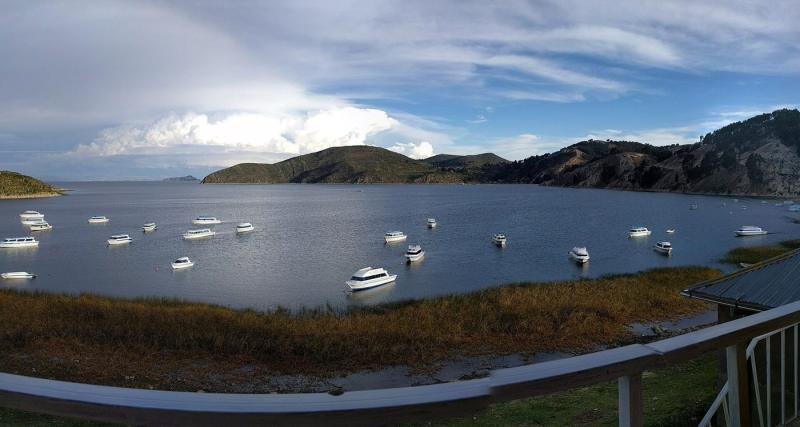
Lake Umayo is a separate lake from Titicaca, about 5 miles (8 km) long and 1.9 miles (3 km) wide, at 12,612 ft (3,844 m). Sillustani stands on the peninsula that pushes into it from the east, so the towers have water on three sides. In the dry months, May to September, the lake is a hard dark blue against yellow grass, and in the late afternoon the towers turn orange in the low sun.
The flat-topped island in the middle of the lake is what most photos frame between two towers. Bring a wide lens and a windproof layer: the wind at the top of the hill is strong and cold even on a sunny afternoon, and the light is best in the last two hours before sunset.
Getting to Sillustani from Puno
Sillustani is about 21 miles (34 km) by road from Puno, northwest of the city, and the drive takes about 45 minutes. The road follows the highway toward Juliaca, then turns west across the plain to the Umayo peninsula. There is no regular public transport to the site itself, so most travelers go on a shared half-day tour from Puno with a guide, or with a taxi or hired driver who waits for them.
A half day is the right amount of time: 45 minutes each way plus about an hour and a half on the hill. Half-day tours from Puno usually leave after lunch, so you reach the towers in the late light. From the parking area a stone path climbs to the top. The climb is short, but at 12,800 ft it is steady work, so walk at the pace of the slowest person and stop to look back at the lake.
Entrance fee and hours
The general entrance fee for Sillustani is S/15 (soles), with S/5 for university students and S/2 for children, according to the Ministerio de Cultura price list in Resolución Ministerial 406-2022-DM-MC. That list also gives half price to people aged 60 and over under Peruvian law, and free entry to residents of Atuncolla. Ask at the gate whether the senior rate applies to foreign visitors. Bring cash in soles.
We do not print opening hours here because we found no official schedule from the Ministerio de Cultura. Confirm the hours with your tour or hotel the day before, and plan to arrive at least an hour and a half before sunset.
Sillustani with a Puno city tour
The easiest way to fit Sillustani in is to pair it with a morning in Puno: the city in the morning, the towers in the afternoon. Start at the main square and the cathedral, walk down Calle Lima, and stop at the Museo Municipal Carlos Dreyer to see the Sillustani pieces. Have lunch, then leave for the site at about 1:30 p.m. and be back in Puno for dinner. Our list of things to do in Puno covers the other stops in town, from the Yavari steamer to the Kuntur Wasi viewpoint.
The other good slot is your arrival or departure day. Sillustani sits off the road to Juliaca, so a stop on the way from or to the airport saves a separate trip. Ask for it when you book the transfer, and leave at least four hours between pickup and your flight.
What people get wrong is trying to squeeze Sillustani into the evening after a full boat day to the Uros and Taquile. You arrive tired and cold, the light is gone and the wind is up. Give it its own half day.
Sillustani, Molloco and the Aymara shore
If you like Sillustani, the Aymara shore south of Puno has more chullpas. The towers of Molloco, on a hill above the road between Chucuito and Juli, are smaller and see far fewer visitors. Our Aymara Route day tour, US$127 per person with lunch and entrances, stops there along with Chucuito, the raised fields and Juli.
Sillustani is not part of our packages at the moment. Ask for it in your free quote and we will add it as a half day to a Puno stay. Most travelers pair it with our Uros and Taquile full day from Puno, US$127 per person: Sillustani on the afternoon you arrive, the islands the next day. All our trips on the lake are listed on the Lake Titicaca tours page, and the Puno altitude and weather guide tells you what to wear on that windy hill.
Sources
- Sillustani, Wikipedia: Qulla builders, Puquina, Inca conquest in the 15th century, tallest tower about 12 m, east-facing openings, ramp, Cobo, 2005 restoration
- Sillustani, Wikipedia in Spanish: Atuncolla, Umayo peninsula, 3,902 m, Mincetur record of 91 towers, three building types, Chullpa del Lagarto 12 m and 7.17 m, Colla occupation 12th to 15th century, Museo Carlos Dreyer
- Lake Umayo, Wikipedia: 3,844 m, about 8 by 3 km
- Ministerio de Cultura, Resolución Ministerial 406-2022-DM-MC, annex of entrance fees (Monumento Arqueológico Sillustani)
Related tours


Questions people ask
How far is Sillustani from Puno?
About 21 miles (34 km) by road, northwest of Puno, which takes about 45 minutes by car or tour minivan. The road heads toward Juliaca and turns west to the Umayo peninsula. With about an hour and a half on the hill, a visit fills half a day, usually an afternoon.
Is Sillustani worth visiting?
Yes, if you have half a day in Puno beyond the boat trip. Sillustani shows the pre-Inca world of the lake: 91 burial towers of the Colla people on a hill above Lake Umayo, quiet and far less crowded than the Uros. Skip it only if you have one day in Puno, which belongs to the islands.
How much is the entrance fee to Sillustani?
S/15 for a general adult ticket, S/5 for university students and S/2 for minors, according to the Ministerio de Cultura fee list in Resolución Ministerial 406-2022-DM-MC (checked October 2026). Residents of Atuncolla enter free. Pay in cash, in soles, at the gate, and confirm the fee on the day, since the ministry updates its list.
Who built the towers of Sillustani?
The Colla (Qulla), a people of the Lake Titicaca basin who most likely spoke Puquina, built the towers between about the 12th and 15th centuries. After the Incas conquered the Colla in the 15th century, the cemetery stayed in use and many towers were refaced with finely cut Inca-style stone.
What is a chullpa?
A chullpa is a stone burial tower of the Andean highlands, built to hold the remains of a family or lineage with their belongings. At Sillustani the towers are round, often wider at the top than at the base, and each has a single small opening facing east, toward the sunrise.
Sillustani or the Uros islands?
Do both if you have two days in Puno, and give the boat day priority if you have one. The Uros and Taquile show the living lake. Sillustani shows the people who ruled the shore before the Incas. They fit together well: Sillustani on the afternoon you arrive, the islands the next morning.
This guide was last reviewed in October 2026. Prices, rules and timetables are quoted with the date we checked them.