




Paracas and the Ballestas Islands: Wildlife Day from Lima
Paracas is a desert bay town about 160 mi (260 km) south of Lima, 3.5 hours by road. The draw is a two-hour boat around the Ballestas Islands, loud with sea lions and Humboldt penguins, and the Paracas National Reserve behind the town. One long day from Lima covers both, and a night away does it better.

In this guide
Short answer: Paracas is a small town on a desert bay about 160 mi (260 km) south of Lima, roughly 3.5 hours by road. People go for two things: a two-hour boat ride around the Ballestas Islands, where sea lions and Humboldt penguins live on the rocks, and the Paracas National Reserve, a protected stretch of desert coast behind the town. You can see both on one long day from Lima, and better on a night away.
The Ballestas boat
The Ballestas Islands are a cluster of rocky islets a few miles off the Paracas peninsula, with a total land area of about 30 acres (0.12 km²) and no human residents. What lives there is loud: South American sea lions in the hundreds, fur seals, Humboldt penguins, Peruvian boobies, guanay cormorants, pelicans and Inca terns. The islands are part of a national reserve for Peru's guano islands run by SERNANP, and nobody lands. The boats circle the rocks and go through the arches, close enough to smell the colony.
Boats leave the El Chaco pier in Paracas in the morning, with the first departures around 8:00 a.m., and the trip lasts about two hours. The ride is in an open speedboat with life jackets, 20 to 40 people per boat. Mornings only is not a sales trick: the wind on this coast rises every afternoon, and the port closes the pier when the sea gets rough.
The Candelabro on the way across
Ten minutes out, the boat slows in front of the Candelabro, a figure cut into the slope of the peninsula, 560 ft (170 m) tall and 200 ft (60 m) wide, dug about 2 ft (60 cm) into the ground and visible from 12 mi (19 km) at sea. Pottery found beside it has been dated to about 200 BC, the time of the Paracas culture. Nobody knows what it was for. A beacon for sailors, a cactus, a trident of a god, take your pick, and the guide will have a favorite.
Penguins, and how to see them
Humboldt penguins live on the Ballestas all year, usually in small groups on the lower ledges, standing still among the birds. Take binoculars or a zoom lens, because the boat keeps its distance from the rocks and penguins at 100 ft look like bowling pins. Sea lions are the sure thing: they loll on every beach of the islands and swim up to the boat. Wildlife is never a guarantee, and a guide who promises you a specific animal is selling you something.
Practical notes. Wear a hat you can tie on, because the birds overhead are many and the boat is open to whatever they drop. Keep a jacket for the ride, which is cold even in summer. Expect fees at the pier: the SERNANP entry for the islands is S/11 per adult (2026 tariff, published by SERNANP's ticket system and reproduced by secondary sites) plus a small dock tax, paid in cash if your tour does not include them.
Paracas National Reserve
The Reserva Nacional de Paracas, created in 1975, protects about 828,000 acres (335,000 hectares) of desert, cliffs and ocean, with about two thirds of that area under water. It is also a Ramsar wetland of international importance, listed in 1992. Around 216 bird species have been recorded, from Chilean flamingos in the bay to Andean condors that come down to the coast to feed on sea lion carcasses.
The land visit is a loop by van or bus on dirt roads across the peninsula, usually two to three hours, and the stops are the same on every tour:
- Playa Roja. A beach of dark red sand under ochre cliffs, colored by the volcanic rock of the headland. You look from above and do not swim.
- La Catedral. A rock arch that was the postcard of the reserve until the earthquake of August 2007 brought most of it down. A cliff and a sea stack remain.
- Lagunillas. A fishing cove with a handful of restaurants that serve ceviche from the morning's catch. Lunch here beats lunch in town.
- The Julio C. Tello site museum. At the reserve entrance, rebuilt after the earthquake and reopened in 2016, on the Paracas culture of about 800 to 100 BC: embroidered textiles, elongated skulls and skull surgery.
The reserve is a desert with wind. Bring sunglasses that wrap around, a scarf for your face and water, and leave the drone at home, since the reserve rules restrict them. The mistake people make is doing the islands and skipping the reserve to save two hours. The boat shows you animals. The reserve shows you the coast those animals depend on, and the red beach is the photo you keep.
From Lima, in a day or with a night
Lima to Paracas is about 160 mi (260 km) on the Panamericana Sur, 3.5 hours in a tour van leaving before dawn and longer on a summer weekend. Our Paracas day tour from Lima picks you up between 4:40 and 5:00 a.m., does the Ballestas boat, a pisco bodega near Ica and the dunes at Huacachina, and drops you back in Lima around 10:30 p.m. for US$207. It is a 17-hour day with about eight hours of it on the road. Worth it once, if that is the only day you have.
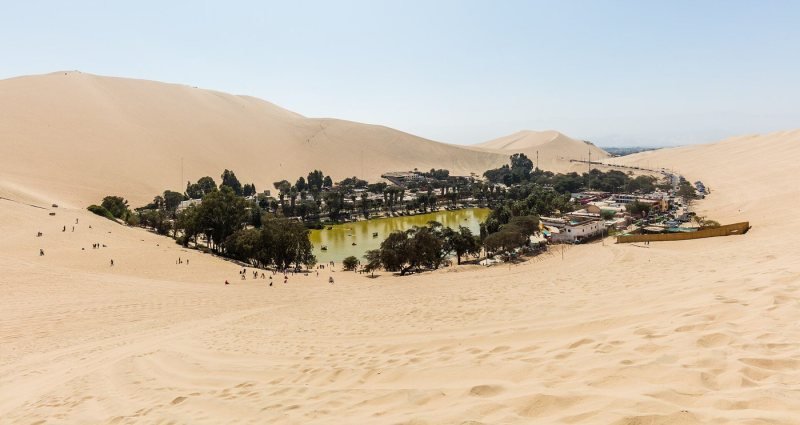
With a night, the trip changes. Sleep in Paracas, take the first boat while the sea is calm, do the reserve loop after lunch and reach Huacachina for the sunset buggy ride, or fly over the Nazca Lines the next morning from the Pisco airport, 25 minutes away. Our 2-day coast tours do exactly that, and our Nazca Lines flight guide explains the two ways to fly. Read the Huacachina guide if the dunes are the reason you are going.
Which month to choose
Any month works for the islands, since the animals are resident. The coast sits under gray fog from May to November, so expect a cool, overcast boat ride at around 64 F (18 C) and sun once you drive inland to Ica. December to March is hot and bright, with Lima's beach crowds on the weekends. August brings the strongest afternoon winds of the year, which is when the Ballestas boats are most often cancelled, so take the earliest departure.
Paracas pairs with Lima at the start of a Peru trip, before the altitude. For the city itself, our guide to things to do in Lima fills the day before. The day trips from Lima page compares all five coast tours side by side.
| Fact | Value | Source |
|---|---|---|
| Distance from Lima | about 260 km (160 mi), about 3.5 hours by road | |
| Ballestas boat | about 2 hours from the El Chaco pier, mornings only, no landing | en.wikipedia.org |
| Ballestas land area | about 0.12 km² (30 acres), uninhabited | en.wikipedia.org |
| SERNANP entry (islands or reserve) | S/11 per adult, S/3 per child aged 5 to 16, same for foreigners (2026 tariff) | tramitesperu.com |
| Candelabro | 170 m (560 ft) tall, 60 m (200 ft) wide, cut 60 cm (2 ft) deep, visible 19 km (12 mi) at sea, pottery nearby about 200 BC | en.wikipedia.org |
| Paracas National Reserve | created September 25, 1975, 335,000 ha (828,000 acres), 65% marine | en.wikipedia.org |
| Ramsar wetland | listed March 30, 1992 | en.wikipedia.org |
| Bird species recorded | about 216 | en.wikipedia.org |
| Paracas culture | about 800 to 100 BC, textiles, elongated skulls, trepanation | en.wikipedia.org |
| Our day tour from Lima | US$207, pickup 4:40 to 5:00 a.m., back about 10:30 p.m. |
Sources
- Paracas National Reserve, Wikipedia (1975, 335,000 ha, Ramsar 1992, 216 bird species)
- Ballestas Islands, Wikipedia (area, species, boat tours, reserve system)
- Paracas Candelabra, Wikipedia (dimensions, dating, visibility)
- Paracas culture, Wikipedia (dates, textiles, trepanation)
- Dezeen, Julio C. Tello site museum rebuilt after the 2007 earthquake
- SERNANP, Tu Ticket (entry fees for protected areas)
Questions people ask
Can you see penguins at Ballestas?
Most days, yes. Humboldt penguins are resident on the islands all year, usually a few at a time on the lower rocks among the cormorants and boobies. The boat keeps its distance, so bring binoculars or a zoom lens. Sea lions are the sure sighting, on the beaches and in the water beside the boat. No tour can promise a specific animal.
How far is Paracas from Lima?
About 160 mi (260 km) south on the Panamericana Sur, which takes about 3.5 hours when the van leaves Lima before dawn and more on a summer weekend. Our day tour leaves between 4:40 and 5:00 a.m. to reach the morning boats and returns around 10:30 p.m. A night in Paracas spreads the same driving over two days.
Do you land on the Ballestas Islands?
No. The islands belong to the SERNANP reserve that protects Peru's guano islands, and landing is not permitted for visitors. The boats circle the rocks and pass through the arches for about two hours, close enough to hear and smell the sea lion colony, then return to the El Chaco pier.
Is Paracas worth visiting?
In our opinion, yes, if you have a free day in Lima at the start of your trip and want wildlife and desert before the Andes. The boat, the red beach and a ceviche at Lagunillas make a full day. Skip it on a short trip built around Cusco and Machu Picchu, where eight hours of road cost you more than they give.
What is the Candelabro of Paracas?
A figure shaped like a three-branched candlestick, 560 ft (170 m) tall, scraped about 2 ft (60 cm) deep into the slope of the peninsula and visible from 12 mi (19 km) at sea. Pottery found beside it dates to about 200 BC. Its purpose is unknown, and every boat to the Ballestas stops in front of it on the way out.
What is the weather like in Paracas?
Desert on the coast: almost no rain, a cool gray overcast from May through November at about 64 F (18 C), and hot bright days from December to March. The wind rises every afternoon and peaks in August, which is why boats go out in the morning and why you want a scarf for your face in the reserve.
This guide was last reviewed in October 2026. Prices, rules and timetables are quoted with the date we checked them.