



Lima to Cusco: Flight or Bus, Times and Costs
Fly. Lima to Cusco is about 1 hour 20 minutes in the air on LATAM, Sky or JetSMART, with departures through the day. The bus takes 21 to 22 hours over the Andes on a road of about 1,100 km (680 mi). Book a morning flight, land at 3,400 m (11,150 ft), and keep the first afternoon light.

In this guide
Short answer: Fly. Lima to Cusco takes about 1 hour 20 minutes in the air, with LATAM, Sky and JetSMART flying the route many times a day. The bus takes 21 to 22 hours over the Andes on about 1,100 km (680 mi) of road, and only makes sense if you break it into stops along the coast. Book a morning flight, because afternoon weather in Cusco cancels more flights than morning weather does, and plan a light first afternoon at 3,400 m (11,150 ft).
The two ways, side by side
Lima sits on the Pacific coast at 154 m (505 ft). Cusco sits in a mountain valley at 3,400 m (11,150 ft), about 570 km (355 mi) away in a straight line and roughly twice that by road, which has to cross the Andes to get there. The plane crosses in a little over an hour. The bus crosses in a day. The choice is about time and altitude, not about price alone, and the table below shows why we put every guest on a flight.
| Flight | Direct bus | Bus in stages | |
|---|---|---|---|
| Time | about 1 h 20 min in the air, half a day door to door with the airport | 21 to 22 hours | 3 to 4 days with Paracas, Huacachina and Nazca |
| Altitude gain | Sea level to 3,400 m in under two hours | Over passes above 4,000 m, arrival tired | Gradual, with the night bus from Nazca at the end |
| Reliability | Morning flights reliable, afternoon flights weather-dependent | Strikes and landslides close the road a few times a year | Same road risk on the last leg |
| Who it suits | Everyone on a vacation of two to three weeks | Almost nobody | Travelers who want the coast and the Nazca Lines on the way |
Flying from Lima to Cusco
The flight is short and simple. Three airlines fly it nonstop: LATAM, the full-service carrier with the most departures, and the low-cost airlines Sky and JetSMART, which sell a bare fare and charge for bags and seats. Scheduled flight time is between 1 hour 20 minutes and 1 hour 30 minutes. The first departures leave Lima before dawn and the last in the early evening, so almost any arrival time in Lima can connect the same day or the next morning.
Lima airport
All flights, domestic and international, have used the new terminal at Jorge Chávez airport since June 1, 2025 (state news agency Andina). If you arrive from the United States and connect to Cusco, you clear immigration and customs, collect your bags, and check in again for the domestic flight in the same building. Allow at least three hours between an international arrival and a domestic departure, more if the two tickets are separate and the first flight is late. If you booked the whole trip with us, we tell you which flight matches your pickup in Cusco and adjust if it moves.
Cusco airport
Cusco's Alejandro Velasco Astete airport (code CUZ) sits in the city at 3,310 m (10,860 ft), ten to fifteen minutes by taxi from the Plaza de Armas. It is small, with a single terminal and no jet bridges, and it closes at night: the approach runs down a valley between hills, so there are no flights after dark. The practical effect is that morning flights are the reliable ones. Afternoon cloud and rain, especially from December to March, cause delays and cancellations that roll into the next day. Book the earliest flight you can bear and treat an afternoon seat as a gamble in the wet months.
A larger airport at Chinchero, in the Sacred Valley, is under construction to replace it. As of early 2026 the project was about one third built and the government was pointing to a late 2027 opening, per press reports. Until it opens, every flight lands in the city.
Bags and fares
Fares change daily and we print none here. The habit that matters is reading the fare rules: the low-cost airlines' cheapest fare includes only a small personal item, and a checked bag or a carry-on costs extra and costs more at the airport than online. LATAM's basic fares do the same on many domestic routes. Book the bag when you book the seat. Trekking poles go in checked luggage, and a duffel for the trek plus a small daypack is the right shape of luggage for the whole trip, since the Machu Picchu trains limit you to a carry-on size bag.
The bus from Lima to Cusco
The direct bus takes 21 to 22 hours and most operators quote about 22 (travel guides tracking the route, as of 2026). The road leaves Lima on the Panamericana south, turns inland at Nazca and climbs over passes above 4,000 m (13,100 ft) through Puquio and Abancay before dropping into Cusco. It is a mountain road with switchbacks for most of the second half, and people who get car sick get car sick here. The better companies run full-size coaches with reclining seats, a bathroom and meals, and a few sell a lie-flat class.
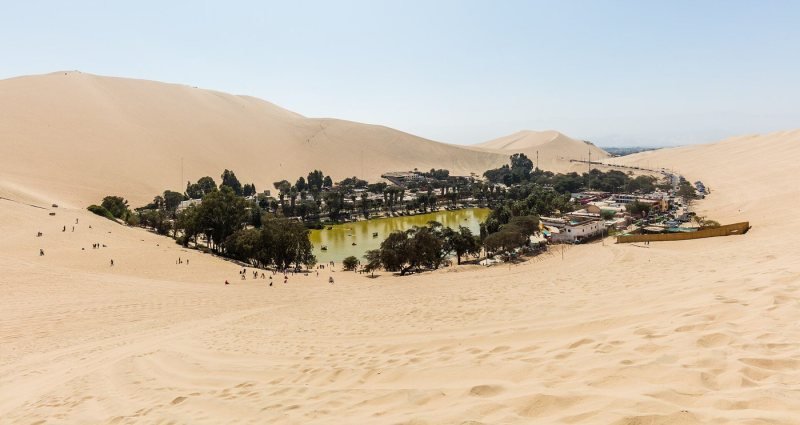
We do not recommend the direct bus to guests with a normal vacation. It costs a day and a night, you arrive tired at altitude, and the saving against a flight is small once you count a hotel night. It makes sense in one case: when the bus is the trip, broken into stops. Lima to Paracas for the Ballestas Islands, Paracas to Huacachina for the dunes, Huacachina to Nazca for the flight over the lines, and then the night bus from Nazca to Cusco, which is the piece our Lima itineraries do by road when they include Nazca. Our guide to the Nazca Lines flight covers that leg.
Arriving at altitude
The flight takes you from sea level to 3,400 m (11,150 ft) in under two hours, which is the fastest altitude gain of your whole trip. The US CDC puts unacclimatized travelers at risk of altitude illness from sleeping altitudes of about 2,450 m (8,000 ft), and Cusco is well above that. Most people feel it as a headache, shortness of breath on the stairs and poor sleep on the first night, and most are fine by the second day. A few get worse, and the answer to that is to go down, which in Cusco means the Sacred Valley at about 2,870 m (9,420 ft).
The day of arrival should be light. Walk slowly, drink water, eat a small lunch, skip alcohol, and leave the city tour for the afternoon rather than the hour you land. Better still, sleep the first night in the Sacred Valley, lower than Cusco, and come up to the city after Machu Picchu. If you take any heart or lung medication, or you want to ask about acetazolamide, that conversation belongs with your doctor before you fly. The Cusco altitude guide covers symptoms, the CDC advice and what our guides carry.
Where to put Lima in the trip
Most Americans land in Lima late at night, and the question is how long to stay before the mountains. Our answer is one or two nights at the start, for the historic center, the Miraflores cliffs and the coast, then Cusco. It breaks the long flight from the United States, and it means you fly to Cusco rested, in the morning. Our guide to things to do in Lima in one or two days has the short list, and the Peru itinerary guide sets the order for a whole trip. If you would rather we handle every transfer and connection, Lima and Cusco in 6 days runs from the Lima airport to Machu Picchu and back to the Cusco airport, from US$880 per person with the flight booked separately on the day we recommend. From Cusco, how to get to Machu Picchu is the next question.
| Fact | Value |
|---|---|
| Flight time | about 1 h 20 min to 1 h 30 min, nonstop |
| Airlines | LATAM, Sky, JetSMART |
| Lima airport | Jorge Chávez (LIM), one new terminal for all flights since June 1, 2025 |
| Cusco airport | Alejandro Velasco Astete (CUZ), in the city, 3,310 m (10,860 ft), daytime operations |
| Chinchero airport | under construction, about one third built in early 2026, target late 2027 per press reports |
| Bus | 21 to 22 hours, about 1,100 km (680 mi) via Nazca and Abancay |
| Altitude change | Lima 154 m (505 ft) to Cusco 3,400 m (11,150 ft) |
| Our package | Lima and Cusco in 6 days, from US$880 per person, flights not included |
Sources
- Andina, Jorge Chávez International Airport's new terminal begins operations (June 1, 2025)
- SkyVector, Alejandro Velasco Astete Airport (SPZO), elevation 10,860 ft
- Airport Technology, Chinchero International Airport project (status and target opening)
- CDC Yellow Book, High Altitude Travel and Altitude Illness
- Cruz del Sur, Lima to Cusco route
Questions people ask
Is it better to fly or take the bus from Lima to Cusco?
Fly. The flight takes about 1 hour 20 minutes and runs many times a day on LATAM, Sky and JetSMART. The direct bus takes 21 to 22 hours over mountain passes and leaves you tired at 3,400 m (11,150 ft). The only good reason to go by road is to break the trip at Paracas, Huacachina and Nazca and take the night bus from Nazca at the end.
How long is the flight from Lima to Cusco?
About 1 hour 20 minutes to 1 hour 30 minutes of scheduled flight time, nonstop. Add the airport: arrive two hours before a domestic flight in Lima, and allow at least three hours if you are connecting from an international arrival, since you collect your bags and check in again in the same terminal.
Why are morning flights to Cusco better?
Cusco's airport sits in a valley at 3,310 m (10,860 ft) and operates in daylight only. Afternoon cloud and rain, heaviest from December to March, cause delays and cancellations that roll into the next day, while mornings are usually clear. Book the earliest flight you can and keep the first afternoon free, which also helps with the altitude.
How far is Cusco from Lima?
About 570 km (355 mi) in a straight line and roughly 1,100 km (680 mi) by road, which has to cross the Andes through Nazca, Puquio and Abancay. That is why the plane takes a little over an hour and the bus takes most of a day. There is no train between the two cities.
Can I go straight from the Cusco airport to Machu Picchu?
Not the same day, in practice. The trains to Aguas Calientes leave from Ollantaytambo, about two hours by road from the airport, and a Machu Picchu visit needs its own morning. The usual plan is to land in Cusco, spend the afternoon in the city or the Sacred Valley, and go to Machu Picchu the next day. Sleeping in the Sacred Valley the first night is the gentlest version.
Is there a new airport in Cusco?
Not yet. Chinchero International Airport in the Sacred Valley is under construction to replace the city airport. Press reports in early 2026 put the works at about one third complete with a government target of late 2027 for opening, after earlier dates slipped. Until it opens, every flight lands at Alejandro Velasco Astete airport in the city of Cusco.
This guide was last reviewed in October 2026. Prices, rules and timetables are quoted with the date we checked them.